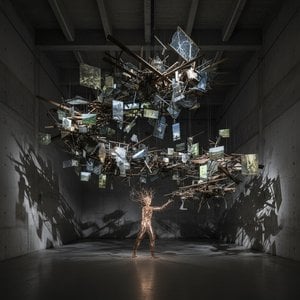
Sylvia Palacios Whitman: Surreal Minimalism and the Choreographic Canvas
Sylvia Palacios Whitman (born August 25, 1941) stands as a singular figure in performance art history—a Chilean-American artist who fused visual painting with movement into an arresting exploration of space, gesture, and materiality. Her work transcends conventional categorization, embodying the spirit of avant-garde experimentation while retaining a profound connection to Latin American artistic traditions. Whitman’s trajectory began in Santiago, Chile, where she honed her skills as a painter and sculptor at Universidad de Chile's Fine Arts School before embarking on a transformative journey to New York City in 1961. This relocation proved pivotal, immersing her in the burgeoning experimental theater scene of the early sixties and establishing collaborations with influential artists like Robert Whitman—a relationship that would profoundly shape her artistic vision.
Early Influences & Training: Whitman’s formative years were steeped in the vibrant currents of Chilean Surrealism and Constructivism. These disciplines instilled within her a deep appreciation for paradoxical juxtapositions – confronting seemingly contradictory ideas – and skillfully manipulating form to convey complex narratives. Her formal education provided foundational knowledge in drawing and sculpture, equipping her with technical precision alongside an imaginative sensibility that would characterize her entire artistic career. The exploration of geometric abstraction, particularly spirals and squares, became recurring motifs reflecting the architectural heritage of Chile and informing her conceptual approach.
Collaboration with Robert Whitman: Whitman’s partnership with Robert Whitman—a fellow performance artist—was instrumental in shaping her distinctive artistic style. Together they embarked on a daring endeavor to merge visual art and theater, pioneering a groundbreaking aesthetic marked by layered imagery and deliberate choreography. Their collaborative projects solidified Whitman's conviction that disparate mediums could converge into unified expressive experiences – a principle she consistently applied throughout her oeuvre. Whitman’s work deliberately disrupted theatrical conventions, prioritizing physicality and spatial exploration—influences directly traceable to the experimental theater movement of New York City during the 1960s.
The Trisha Brown Dance Company Years (1970-1973): Whitman's association with Trisha Brown’s dance company represented a crucial juncture in her artistic evolution. This immersive experience exposed her to “choreographic theater,” where movement served as an integral component of storytelling and visual presentation—a paradigm shift that profoundly impacted her subsequent artistic endeavors. Performances by Brown challenged established theatrical norms, emphasizing bodily presence and spatial dynamism – concepts Whitman internalized and translated into her own groundbreaking performances. The exploration of repetitive movements mirroring daily rhythms alongside unexpected gestures constituted a core element of Whitman’s aesthetic language.
Notable Performances & Artistic Legacy: Whitman's performance practice centered on crafting evocative environments populated by meticulously chosen props and costumes—often incorporating found objects—that functioned as both symbolic representations and active participants in the unfolding drama. Her productions garnered acclaim for their conceptual rigor and understated beauty, notably *Going* (1974), *Soup & Tart* (1975), *Red Cone* (1976), *Passing Through* (1977), *Negatives* (1981) and *South*(1979). These pieces interrogated themes of identity, displacement, and the negotiation between individual perception and collective consciousness—subjects that resonated deeply with audiences worldwide. Whitman’s retrospective exhibitions at institutions like Hammer Museum and the Whitney Museum cemented her position as an artist whose singular vision captivated viewers and continues to inspire artists interested in pushing artistic boundaries. Her unwavering commitment to surreal minimalism and the choreographic canvas ensured her enduring legacy as a pioneer of performance art and a champion of innovative artistic expression.