Biography of Sybrand van Beest
Sybrand van Beest (c.1610 – 1674) stands as a testament to the serene beauty and meticulous observation characteristic of Dutch Golden Age painting. Born in The Hague around 1610, his artistic journey unfolded against the backdrop of a period defined by intellectual ferment and artistic innovation—a legacy inextricably linked to luminaries like Rembrandt and Jan van Goyen. While precise biographical details remain elusive, scholars agree that Van Beest’s formative years were spent under the tutelage of Adriaen van de Venne, whose influence profoundly shaped his stylistic sensibilities.
- Early Influences: Van Beest's artistic education began with Adriaen van de Venne, a master painter known for his dramatic landscapes and masterful use of chiaroscuro—a technique that would become a cornerstone of Van Beest’s own oeuvre.
- The Style of Jan van Goyen: Equally significant was the mentorship of Jan van Goyen, whose distinctive approach to landscape painting emphasized atmospheric perspective and subtle tonal gradations. This stylistic kinship is palpable in many of Van Beest's canvases.
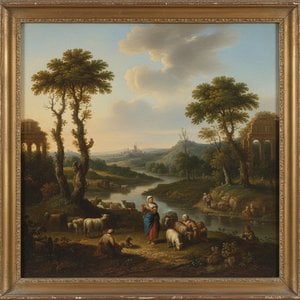
Van Beest’s artistic output primarily focused on landscapes populated with figures—a genre that resonated deeply with the humanist ideals prevalent during his time. Unlike some contemporaries who favored grand narratives or mythological subjects, Van Beest skillfully captured scenes from rural life, portraying farmers tending their fields, shepherds guiding flocks, and villagers engaged in everyday activities. His depictions weren’t merely aesthetically pleasing; they served as a poignant reflection of Dutch society and its connection to the natural world.
- Notable Works: Among his most celebrated paintings is “The Legation from the Tsar of Muscovy on Its Way to a Meeting of the States-General in The Hague,” a monumental composition that exemplifies Van Beest’s mastery of perspective and compositional balance.
His artistic technique—characterized by meticulous detail, luminous color palettes, and an unwavering commitment to realism—mirrors the stylistic conventions established by Isaac van Ostade, another influential artist of his era. This convergence of influences resulted in landscapes imbued with a palpable sense of tranquility and immediacy—images that continue to captivate viewers centuries later.
- Legacy: Sybrand van Beest’s contribution to Dutch landscape painting is recognized for its understated elegance and profound psychological insight. His works reside within prestigious collections like the Mauritshuis Royal Picture Gallery and the Rijksdienst Beeldende Kunst Museum, ensuring that his artistic vision persists as a beacon of beauty and observation.
The artist passed away in Amsterdam in 1674, leaving behind an enduring legacy—a testament to the power of art to encapsulate both the grandeur of history and the quiet dignity of human experience.