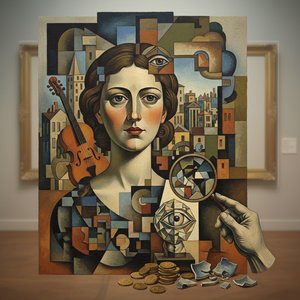
Stasys Ušinskas: A Pioneer of Lithuanian Modernism
Stasys Ušinskas (20 July 1905 – 14 June 1974) stands as a singular figure in Lithuanian art history—a “father of Lithuanian stained glass art,” as he’s rightfully recognized—whose multifaceted talent spanned painting, scenography, animation, puppetry, and decorative glassworks. Born in Pakruojis, Lithuania, to Juozas Ušinskas, a stonebreaker, and Sofija Ušinskaitė, his early life instilled within him a profound appreciation for craftsmanship and observation of the natural world—influences that would permeate his artistic vision throughout his prolific career. His formative years included time spent in the United States before returning to Lithuania in 1914, where he pursued formal education at Šiauliai Gymnasium, laying the groundwork for his subsequent studies at Kaunas Art School and later at Académie Julian in Paris.Early Life and Education
Stasys Ušinskas’s childhood was marked by a connection to the traditions of Lithuanian stonebreaking—a craft practiced by his father—and instilled within him an acute sensitivity to detail and natural forms. Between 1908 (1909?) and 1914, the family resided in the United States, providing him with exposure to diverse cultural perspectives. In 1914, he returned to Lithuania and completed his secondary education at Šiauliai Gymnasium, equipping him with a solid intellectual foundation for his artistic pursuits. From 1925 to 1929, he honed his painting skills at Kaunas Art School under the guidance of Justinas Vienožinskis—a formative experience that nurtured his understanding of Lithuanian artistic heritage and established connections within the burgeoning Lithuanian art community. Notably, Vienožinskis encouraged Ušinskas’s exploration of avant-garde movements, fostering a spirit of experimentation and challenging conventional artistic norms.Parisian Training and Artistic Influences
Paris proved to be an indispensable catalyst for Ušinskas's artistic evolution. The Académie Julian exposed him to the vibrant currents of modernist art—particularly Cubism and Art Deco—introducing him to influential artists like Henri-Marcel Magne, whose lectures profoundly impacted his grasp of theatrical design and visual storytelling. Magne’s emphasis on dramatic composition and expressive gesture instilled in Ušinskas a conviction that art should engage audiences emotionally and intellectually. This exposure fostered a collaborative spirit, encouraging him to engage with Aleksandra Ekster—a fellow Académie Julian student who championed radical experimentation and pushed him toward exploring unconventional artistic mediums. Ekster's unwavering belief in the transformative power of art fueled Ušinskas’s ambition to transcend traditional boundaries and forge new paths for Lithuanian artistic expression. Her influence specifically encouraged him to delve into puppetry, recognizing its capacity as a powerful tool for conveying complex narratives and eliciting visceral responses from viewers—a fascination that would characterize much of his later work.A Diverse Artistic Output: Painting & Stained Glass
Ušinskas’s artistic output was remarkably varied, reflecting his boundless curiosity and intellectual engagement. His paintings exemplify modernist principles—characterized by geometric abstraction, flattened perspectives, and bold color palettes—often portraying landscapes imbued with symbolic resonance. “The Bather,” completed in 1931, exemplifies this style perfectly: a stylized nude rendered in warm hues against simplified geometric shapes, embodying the spirit of Lithuanian Art Deco and reflecting Ušinskas’s fascination with natural forms filtered through Cubist fragmentation. Beyond painting, he revolutionized Lithuanian stained glass art—establishing it as a distinct artistic discipline and elevating its aesthetic standards. His meticulous craftsmanship combined with innovative compositional techniques—drawing inspiration from Cubist fragmentation and Art Deco ornamentation—created breathtaking artworks that continue to captivate audiences today. The Central State Archives of Lithuania recognized his contribution as an object of documentary heritage of national significance, cementing his place in Lithuanian cultural history.Animation & Puppetry: Expanding Artistic Horizons
Recognizing the potential for artistic expression beyond traditional mediums, Ušinskas ventured into animation and puppetry—disciplines that demanded both technical skill and imaginative vision. He conceived and executed several animated films—including “The Dream of the Fatty”—that showcased his mastery of visual storytelling and experimental filmmaking techniques. His puppet theatre productions were equally ambitious, blending theatrical performance with intricate marionette craftsmanship and narratives rooted in Lithuanian folklore and mythology. The Kaunas State Puppet Theatre proudly displays Ušinskas’s puppets—a testament to his enduring influence on Lithuanian puppetry tradition—and his pioneering role as the inventor of the “author’s theatre” and the precursor of the “artist’s theatre”. His legacy extends beyond individual artworks, shaping the very ethos of Lithuanian artistic creativity.Preguntas y respuestas
¿Dónde se pueden explorar las obras de Stasys Ušinskas clasificadas por tema?
Las obras de Stasys Ušinskas pueden explorarse por tema en la página Atlas de temas del artista.
¿Cómo se divide la trayectoria de Stasys Ušinskas en periodos?
Un relato cronológico de la obra de Stasys Ušinskas está disponible en la página Crónica del artista, donde las obras se presentan en orden de creación, capítulo a capítulo.
¿Cómo puedo encontrar obras de Stasys Ušinskas sobre un tema específico?
Las obras de Stasys Ušinskas pueden explorarse por palabra clave en la página de Por palabras clave del artista. Cada palabra clave agrupa las obras relacionadas.