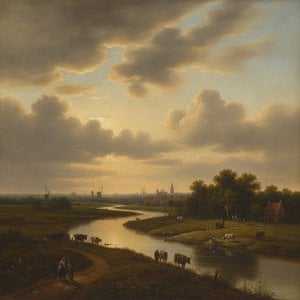
Samuel Dirksz van Hoogstraten: A Master of Illusion and Intellect
Samuel Dirksz van Hoogstraten (1627-1678) stands as a towering figure in the annals of Dutch Baroque painting, an artist whose legacy extends far beyond the canvases he graced. Born in Dordrecht, Holland, into a family steeped in artisanal tradition—his father Dirk van Hoogstraten was a silversmith and painter—Samuel’s early life foreshadowed his artistic destiny. From a young age, he demonstrated an unwavering passion for drawing and engraving, nurtured by his father's tutelage and laying the groundwork for his future mastery of perspective and illusionism. His familial background instilled in him not only technical skills but also a profound appreciation for craftsmanship and aesthetic refinement—values that would permeate throughout his artistic endeavors.- Early Training & Family Background: Samuel’s father, Dirk van Hoogstraten, imparted invaluable knowledge of painting techniques and fostered an enduring love for the visual arts within his son. The family’s lineage traced back to Dordrecht’s artisan guilds, emphasizing a tradition of excellence and meticulous attention to detail.
- Amsterdam & Rembrandt’s Influence: At the age of seven, Samuel moved to Amsterdam, where he enrolled in the workshop of Rembrandt van Rijn—a pivotal moment that irrevocably shaped his artistic style. Rembrandt's mastery of chiaroscuro and dramatic lighting served as a formative influence, guiding Samuel toward an expressive approach rooted in observation and psychological insight.
- Travels & Artistic Exploration: Driven by intellectual curiosity and a desire to broaden his horizons, Samuel embarked on extensive journeys throughout Europe—to Vienna, Rome, and London—immersing himself in diverse artistic traditions and absorbing inspiration from masters across the continent. These expeditions fueled his understanding of architectural principles and spatial perception, enriching his artistic vision.
The Art of Trompe-l’œil & Perspective Boxes: Deconstructing Reality
Samuel van Hoogstraten distinguished himself as a pioneer in the realm of trompe-l’œil—a technique that translates to “deceive the eye”—and he achieved unparalleled renown for his creation of perspective boxes. These ingenious devices weren't merely decorative curiosities; they were sophisticated explorations of visual perception, demonstrating Van Hoogstraten’s profound grasp of how the human eye perceives depth and dimension. He imbued seemingly simple arrangements with complex symbolic meanings, inviting viewers to contemplate the illusory nature of reality and challenging conventional notions of representation. His meticulous attention to detail—evident in his still lifes and architectural paintings—reflected a commitment to capturing not just what was seen but also how it appeared to be perceived.- Still Life Illusionism: Van Hoogstraten’s still lifes captivated audiences with their masterful use of illusionistic techniques, blurring the boundaries between reality and representation. He skillfully manipulated light and shadow to create dramatic effects and imbue his compositions with symbolic resonance.
- Perspective Boxes & Spatial Depth: His perspective boxes—such as the one housed at the National Gallery in London—were groundbreaking achievements in spatial illusionism, offering immersive views into miniature worlds that defied conventional perspective conventions.
A Theoretician’s Legacy: Inleyding tot de Hooge Schoole der Schilderkonst
Beyond his artistic creations, Samuel Dirksz van Hoogstraten left an indelible mark on the history of art theory through his magnum opus, *Inleyding tot de hooge schoole der schilderkonst* (Introduction to the Academy of Painting), published in 1678. This ambitious treatise stands as one of the most comprehensive and intellectually stimulating explorations of painting principles produced in the Dutch Republic during the seventeenth century—a testament to Van Hoogstraten’s unwavering dedication to articulating the underlying mechanisms of artistic creation. He meticulously examined issues of pictorial persuasion, illusionism, moral considerations for the artist, and the relationship between painting and philosophy, drawing upon a vast repository of knowledge gleaned from both classical antiquity and contemporary European scholarship. His work represents a culmination of his lifelong pursuit of understanding—a synthesis of observation, experimentation, and reasoned argumentation that cemented his position as a pivotal figure in shaping artistic discourse.- Theoretical Framework: Van Hoogstraten’s treatise established a systematic framework for analyzing painting techniques and exploring the philosophical implications of visual representation.
- Influence on Subsequent Artists: His writings profoundly impacted subsequent generations of painters, fostering debates about aesthetic ideals and inspiring innovations in artistic practice.
Concluding Reflections: An Enduring Vision
Samuel Dirksz van Hoogstraten’s legacy continues to resonate today—a testament to his enduring vision and unwavering commitment to artistic excellence. His masterful paintings—characterized by their luminous chiaroscuro, meticulous detail, and profound psychological insight—remain treasured masterpieces of the Dutch Baroque period. Furthermore, his groundbreaking explorations into perspective and illusionism continue to fascinate scholars and artists alike. As a poet and theorist, Van Hoogstraten embodied the intellectual dynamism of his era—a beacon of creativity and erudition whose work transcends time, securing his place as one of the most influential figures in the history of Dutch art.Preguntas y respuestas
¿Qué colores utilizaba con más frecuencia Samuel van Hoogstraten?
El perfil cromático de la obra de Samuel van Hoogstraten se muestra en la página Genoma de la Paleta del artista.
¿Dónde se pueden explorar las obras de Samuel van Hoogstraten clasificadas por tema?
La página Atlas de temas organiza las obras de Samuel van Hoogstraten por tema.
¿Existe una lista completa de las obras de Samuel van Hoogstraten?
Todas las obras de Samuel van Hoogstraten en este sitio web pueden explorarse desde la página de Todas las obras del artista.