early life and artistic beginnings
Samir Rafi, born in Cairo, Egypt, on August 15, 1926, embarked on his artistic journey at the age of seventeen when he participated in his inaugural exhibition alongside Shafiq Rizq, a watercolor painter. This formative experience immediately established him as an emerging talent within the Egyptian modernist movement, blending influences from Western avant-garde styles with deep roots in ancient Egyptian iconography and symbolism. His father, a Muslim lawyer, instilled in him a strong moral compass and intellectual curiosity, while his mother, a Christian educator, nurtured his passion for languages and broadened his worldview. Rafi’s artistic education commenced at the Faculty of Fine Arts in Cairo where he honed his skills under the guidance of prominent educators like Hussein Youssef Amin (1904-1984), who recognized his innate aptitude for visual expression. This early exposure to diverse artistic perspectives would prove instrumental in shaping his distinctive style and worldview.artistic influences and education
Rafi’s artistic vision was profoundly shaped by the revolutionary ideas of Cubism and Surrealism, movements that challenged conventional perceptions of reality and championed experimentation with form and color. He diligently studied these influential currents at the Sorbonne University in Paris, where he benefited from the mentorship of André Lhote (1885-1962), a pioneer of abstract art who instilled in him a commitment to intellectual rigor and artistic innovation. During his Parisian studies, Rafi immersed himself in the vibrant cultural landscape of the city, encountering fellow artists and intellectuals who fostered dialogue and debate about the role of art in society. He pursued doctoral research at La Sorbonne University focusing on Art History, furthering his understanding of artistic traditions across time and space.teaching and exhibitions
Following graduation, Rafi returned to Cairo where he continued his teaching career, imparting knowledge of art history and decorative arts to generations of students. He established himself as a respected educator who championed critical thinking and encouraged creative exploration. His pedagogical approach reflected his belief in the transformative power of artistic engagement—a conviction that would permeate his subsequent artistic endeavors. Rafi’s prolific output spanned decades, producing an impressive body of paintings and sculptures that captured both monumental landscapes and intimate portraits. He exhibited extensively throughout Egypt and internationally, garnering critical acclaim for his daring stylistic choices and conceptual depth. Notably, one of his canvases achieved a remarkable price of £87,500 at Christie’s auction in 2019, cementing his legacy as a significant figure within the global art market.artistic legacy
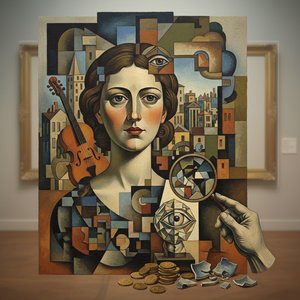
Rafi's artistic legacy is characterized by its unwavering commitment to exploring universal themes—love, loss, spirituality—through innovative visual languages. He skillfully combined elements of Egyptian folklore and mythology with modernist techniques such as collage and assemblage, creating artworks that resonated deeply with audiences across cultures. His distinctive style—often described as “Totalisme” or “Insanity”—was marked by bold color palettes, geometric compositions, and a preoccupation with psychological states. Rafi’s influence extended beyond his own artistic creations; he mentored younger artists who embraced his experimental approach and championed the importance of intellectual curiosity alongside aesthetic sensibility. He remains remembered as one of Egypt's foremost modernist painters—a visionary artist whose work continues to inspire contemplation and provoke dialogue about the complexities of human experience.Preguntas y respuestas
¿Dónde puedo explorar las obras de Samir Rafi organizadas por color?
El Índice de color de Samir Rafi organiza las obras del artista por colores.
¿Dónde se pueden explorar las obras de Samir Rafi agrupadas por palabras clave?
La página Por palabras clave de Samir Rafi agrupa las obras del artista por palabras clave.
¿Dónde y cuándo nació Samir Rafi?
Samir Rafi nació en Cairo en 1926.