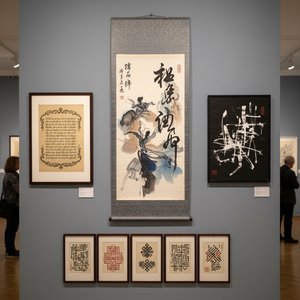
Sabah Arbilli: Reimagining Arabic Calligraphy Through Abstract Expression
Sabah Arbilli, born in Iraq in 1977, is a British-Iraqi artist whose distinctive approach to Arabic calligraphy has garnered international acclaim. His artistic journey began with an unexpected detour from civil engineering—a childhood fascination with the intricate geometry of Arabic letter formation ignited a passion for visual arts and ultimately led him to pursue a Master’s degree at the University of Wales. As Arbilli recounts in interviews, he found the composition and rhythm of Arabic letters profoundly beautiful, recalling formative moments spent honing his handwriting skills during school holidays where he took on calligraphy commissions – crafting signage for buildings and designing wedding invitations. This early exposure to lettering instilled within him a deep appreciation for form and structure, mirroring elements that would later permeate his artistic practice.
- Early Influences: Arbilli’s formative years were marked by an unwavering dedication to mastering Arabic calligraphy, recognizing its inherent aesthetic qualities as well as its symbolic importance in Islamic art and culture.
He honed his skills during university studies, gaining a Master's degree in Visual Arts from the University of Wales where he explored diverse artistic mediums and techniques. Arbilli’s artistic style evolved dramatically from traditional calligraphy to abstract interpretations of letters—a bold reimagining that distinguishes him within the contemporary art landscape. He skillfully blends influences from geometric forms and structural principles derived from his engineering background with the expressive potential of painting, sculpture, ceramics, and installation. Arbilli's work delves into themes of identity, migration, and political commentary, often utilizing allegorical narratives rooted in personal experience and responding to pressing social issues. “The words in my work challenge you to explore the text,” he explains, “work your way around the meaning looking at the colour, composition and space. The secret thought of the audience prods to make you think beyond the often superficial messages beneath the surface.”
- Mediums & Techniques: Arbilli’s artistic repertoire spans a wide range of mediums including painting, sculpture, ceramics and installation, demonstrating his versatility as an artist.
His commitment to artistic excellence has been recognized globally—winning numerous awards for his calligraphy skills and earning invitations as an expert advisor and consultant in the field. Arbilli’s monumental outdoor sculptures adorn architectural buildings across Qatar and Australia, reflecting his dedication to public art projects and furthering dialogue about cultural heritage. Notably, he was selected as a permanent piece for the opening of the Islamic Museum of Australia and United Nations—a testament to his artistic vision and its resonance with international institutions. Arbilli's exploration of abstract compositions represents a significant departure from traditional calligraphy while retaining its core essence – the transformative power of language and letterforms.
- Notable Achievements: Arbilli’s sculptures have been showcased in prominent locations, including Qatar and Australia, solidifying his reputation as a visionary artist.
Arbilli's artworks are held in private collections worldwide and contribute to enriching cultural discourse through their exploration of identity and social commentary. His enduring legacy lies in redefining Arabic calligraphy as an instrument for abstract expression—a bold undertaking that elevates it beyond mere ornamentation into a vehicle for profound artistic contemplation.