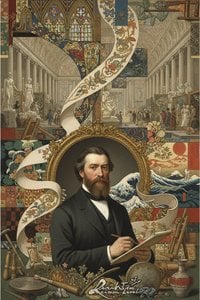
José María Oscar Rodolfo Bernardelli y Thierry (18 December 1852 – 7 April 1931)
José Maria Oscar Rodolfo Bernardelli y Thierry, commonly known as Rodolfo Bernardelli, was a Mexican-born Brazilian sculptor and art professor of Italian ancestry. Born in Guadalajara, Mexico on December 18, 1852, he descended from a family steeped in artistic tradition—his father was a violinist, and his mother a dancer—influences that would profoundly shape his lifelong dedication to sculpting and fostering artistic education. His brothers, Félix and Henrique Bernardelli, also pursued careers in the arts, Félix as a musician mirroring Rodolfo’s own passion for creative expression. Early Life and Family Circumstances
The Bernardelli family experienced considerable movement throughout Rodolfo's formative years, traversing Mexico, Chile, and eventually settling in Rio Grande do Sul, Brazil. This itinerant upbringing exposed him to diverse cultural landscapes and fostered an appreciation for artistic traditions beyond his native Guadalajara. Notably, he encountered Emperor Pedro II during this period, who recognized his talent and invited him to reside in Rio de Janeiro and serve as tutor to the imperial children—a pivotal moment that solidified his connection with Brazilian intellectual life. This early exposure to royal patronage instilled in Bernardelli a sense of responsibility toward artistic excellence and a commitment to shaping young minds through instruction.
Formal Education and Artistic Training
Rodolfo’s artistic journey commenced with studies in Mexico before relocating to Brazil in 1871. He enrolled at the Imperial Academy of Fine Arts in Rio de Janeiro, where he honed his sculptural skills under the tutelage of Francisco Manuel Chaves Pinheiro—a teacher who recognized Bernardelli's enthusiasm and steered him toward a formal academic path. This mentorship proved invaluable, shaping Bernardelli’s stylistic sensibilities and establishing him as one of Brazil’s foremost sculptors. He swiftly gained acclaim for his meticulous craftsmanship and adherence to classical principles, earning numerous prestigious awards that acknowledged his exceptional talent. Chaves Pinheiro instilled in Bernardelli the importance of mastering technique and grounding artistic vision in historical precedent—a lesson that would resonate throughout his career.
A Parisian Disillusionment and Return to Rome
Initially intending to pursue studies in Paris—a customary practice among aspiring artists—Bernardelli found the Parisian artistic milieu underwhelming. The crowded academies and lack of genuine inspiration prompted him to reconsider his ambitions and instead journeyed to Rome, Italy, where he studied with Giulio Monteverde—a sculptor who championed classical ideals and encouraged Bernardelli to embrace a more contemplative approach to artmaking. Despite expressing admiration for Monteverde’s teachings, Bernardelli soon recognized the limitations of purely academic pursuits and began experimenting with contemporary artistic trends. His correspondence back to the Academia reflected this evolving perspective, signaling a departure from rigid formalism toward greater expressive freedom. He sought inspiration in the grandeur of Roman sculpture, recognizing its enduring power to communicate universal themes of beauty and virtue.
Career Highlights and Monumental Achievements
Bernardelli's return to Brazil in 1885 marked the commencement of his prolific sculptural career—a period characterized by significant commissions and collaborations with prominent figures of Brazilian society. He was appointed Professor of Statuary at the Academia Imperial, succeeding Chaves Pinheiro, who had retired, and subsequently served as its director for twenty-five years—a role that cemented Bernardelli’s position as Brazil's foremost sculptor and established him as a champion of artistic education within Rio de Janeiro. His influence extended beyond the Academy walls, shaping the intellectual landscape of the capital and fostering a generation of Brazilian artists. Among his most celebrated works are monumental sculptures commemorating national heroes—the Osório Monument in Lisbon, Portugal, honoring Admiral Miguel Luís Osório da Silveira, and the Caxias Monument in Curitiba, Paraná, Paraná, commemorating Duque de Caxias—which stand as enduring symbols of Brazilian history and artistic excellence. Furthermore, he contributed six ornamental statues for Teatro Municipal in Rio de Janeiro, showcasing his mastery of technique and aesthetic vision. His legacy continues to inspire artists and scholars alike, securing his place among the titans of Brazilian sculpture.