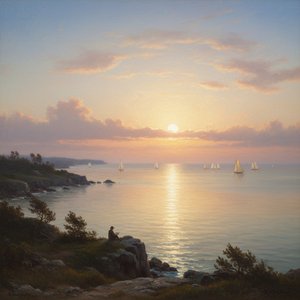
Richard Thomas Pentreath (1806 – 1869): Bridging Romantic Landscape and Cornish Folklore
Richard Thomas Pentreath (1806 – 1869) stands as a pivotal figure in British landscape painting during the Victorian era, blending meticulous observation with an infusion of Cornish folklore and mythology. Born in Cornwall, Pentreath’s artistic journey was shaped by his upbringing amidst the rugged coastline and ancient traditions of West Cornwall, influences that permeate his evocative canvases—a testament to his ability to capture both the grandeur of nature and the spirit of a disappearing culture.
- Early Life & Education: Pentreath received his initial artistic training from his father, William Pentreath, a noted watercolorist who instilled in him a deep appreciation for tonal harmony and atmospheric perspective—techniques that would become hallmarks of Pentreath’s distinctive style.
- Parisian Influences: Recognizing the importance of formal education, Pentreath traveled to Paris in 1827 where he studied under Jean-Hippolyte Michaud, absorbing the Impressionist ideals championed by artists like Claude Monet and Frédéric Bazille. This exposure broadened his artistic horizons and encouraged him to experiment with looser brushstrokes and brighter palettes.
A Cornish Vision: Landscape Painting Rooted in Myth & Legend
Pentreath’s oeuvre is characterized by a profound engagement with the Cornish landscape—specifically, the dramatic coastline of Cornwall. Unlike many artists of his time who sought idealized representations of pastoral beauty, Pentreath deliberately incorporated elements of Cornish folklore and mythology into his paintings. Recurring motifs include depictions of Kernow y Werdh (The Old Cornwall), the mythical Cornish kingdom ruled by King Arthur, and references to ancient pagan rituals—reflecting a desire to preserve the cultural heritage of Cornwall as it faced increasing urbanization and industrialization.
Technique & Style: Mastering Atmospheric Perspective
Pentreath’s artistic technique was rooted in the principles of tonal harmony and atmospheric perspective, honed during his formative years under William Turner. He meticulously studied Turner's masterful use of light and shadow to convey depth and mood—a skill he skillfully applied to his own landscapes. Pentreath favored oil paints on canvas, employing a layering process that allowed him to build up rich textures and create luminous effects. His brushstrokes were often loose and expressive, capturing the dynamism of the Cornish windswept coastlines.
Notable Works & Recognition
Among Pentreath’s most celebrated paintings are “View from Madron Carn” (1839), a breathtaking depiction of Cornwall's rugged cliffs and turbulent seas—considered by many critics to be one of the finest landscapes produced in Britain during the Victorian period. He also created “Reverend B. A. Simmons,” a portrait capturing the solemn dignity of Cornish clergyman Reverend Simmons, demonstrating Pentreath’s versatility as an artist.
Legacy & Historical Significance
Richard Thomas Pentreath's contribution to British landscape painting extends beyond mere aesthetic beauty; he served as a conduit for preserving Cornwall’s cultural identity. His paintings continue to inspire admiration for their masterful execution and profound connection to Cornish folklore—a reminder of the importance of artistic engagement with local traditions and landscapes. He remains an influential figure in Victorian art history, embodying the Romantic spirit's fascination with both sublime natural grandeur and the enduring power of myth.