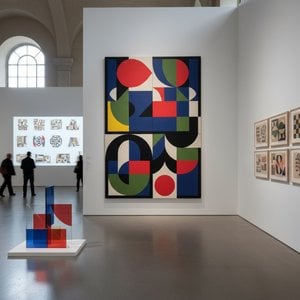
Regina Aprijaskis (1919 – 2013): A Pioneer of Peruvian Geometric Abstraction
Regina Aprijaskis, born in Bordeaux, France, in 1919, stands as a pivotal figure in Peru’s artistic landscape—a testament to the enduring power of geometric abstraction and constructivist principles. Her journey began amidst the vibrant cultural milieu of Lima, where she resided from her infancy, shaping her worldview and fueling her creative spirit. Moving to Peru at just five years old, Aprijaskis experienced a formative childhood immersed in Andean traditions before returning to Bulgaria for her studies, marking an early exposure to European artistic currents.
Early Training and Influences
Aprijaskis’ artistic education commenced with Camilo Blas at the Escuela Nacional de Bellas Artes in Lima, where she absorbed foundational techniques of figurative painting—a grounding that would later inform her exploration of abstraction. Blas instilled in her a meticulous attention to detail and an understanding of classical composition, elements that subtly permeate her oeuvre. Simultaneously, José Sabogal’s mentorship provided invaluable insight into the expressive potential of nude paintings, fostering a sensitivity to form and gesture. Her friendship with Julia Codesido further enriched her artistic perspective, introducing her to the dynamism of New York City and its avant-garde scene.
The Impact of Abstract Expressionism
A transformative encounter occurred during Aprijaskis’ travels to New York in the 1950s—a period profoundly influenced by Mark Rothko and Barnett Newman. These artists championed a radical departure from representational art, prioritizing color and texture as primary vehicles for conveying emotion and exploring the sublime qualities of visual experience. This exposure ignited Aprijaskis' passion for abstract expressionism, propelling her toward a stylistic shift characterized by bold colors and monumental shapes—a deliberate rejection of illusionistic realism in favor of pure form.
The Theodoros Stamos Workshop and Geometric Abstraction
Her decision to enroll in Theodoros Stamos’s workshop solidified Aprijaskis' commitment to geometric abstraction. Stamos, a pioneer of action painting and a fervent advocate for constructivist principles, encouraged her experimentation with spatial relationships and compositional strategies—techniques that would become hallmarks of her artistic practice. This immersive experience nurtured her understanding of the visual language of abstraction and cemented her position as one of Peru’s foremost proponents of this influential movement.
Notable Works and Recognition
Aprijaskis achieved international acclaim for her *Paracas* series, initiated in 1968—a collection of paintings that captured the essence of Andean landscapes through simplified geometric forms imbued with vibrant hues. Critics lauded her work for its intellectual rigor and aesthetic innovation, recognizing it as a cornerstone of Peru’s modernist heritage. Jorge Villacorta eloquently described Aprijaskis' contribution as “one of the few solid proposals of geometric abstraction or on the base of constructivist principles that have developed in the panorama of Peru’s visual arts,” underscoring her enduring legacy within Peruvian art history. Her paintings reside in prestigious collections, including the MAC-Lima Museum and are celebrated for their uncompromising dedication to pure form and color—a testament to Aprijaskis' unwavering artistic vision.