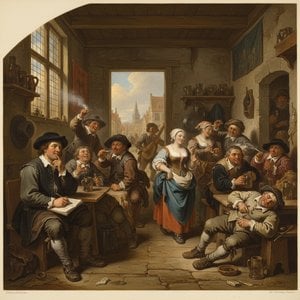
Peter Paillou the Younger: A Delicate Hand Shaping British Portraiture
Peter Paillou (the younger) (1757–1831 or 1832), a natural history painter and illustrator, stands as a testament to the elegance and precision of late Georgian portraiture. Born in London, he inherited his father’s passion for meticulous observation and artistic skill—a lineage that profoundly shaped his distinctive style and enduring legacy within British art history. While biographical details remain somewhat sparse, scholarly research suggests Paillou's origins lay in France before establishing himself as a respected artist in England.
Early Life & Training: Seeds of Observation
Little is known about Paillou’s formative years beyond his father’s influence. Peter Paillou Sr., a celebrated naturalist and illustrator, instilled in his son a dedication to scientific accuracy combined with artistic sensitivity—a crucial blend for capturing the nuances of human character. His father's meticulous drawings of flora and fauna served as an invaluable model for Paillou’s own approach to visual representation, fostering a conviction that beauty could be achieved through careful study and precise rendering. This foundational training would prove instrumental in shaping his artistic vision throughout his career.
London Years & Artistic Practice: Miniature Mastery
Paillou spent two decades honing his craft in London, where he cultivated a reputation as a skilled miniature painter and portrait artist. Advertisements from 1803 reveal his pricing structure – eight guineas for miniatures and ten guineas for three-quarter length portraits—demonstrating the considerable demand for refined artistic commissions during this period. He established himself in St James’s Street, attracting clients eager to commemorate their families with exquisitely detailed depictions of their likenesses. Paillou's studio was a hub of artistic activity, fostering collaborations with fellow artists and contributing to the vibrant intellectual landscape of Georgian London.
A Style Defined by Grace & Detail: Rococo Refinement
Paillou’s artistic style is characterized by an exquisite blend of realism and decorative elegance, particularly evident in his miniature portraits. He eschewed flamboyant Baroque grandeur for a restrained aesthetic that prioritized subtle tonal gradations and meticulous rendering of textures—a hallmark of Rococo sensibilities filtered through the lens of Enlightenment thought. Unlike many artists of his time who sought to overwhelm the viewer with opulent ornamentation, Paillou favored compositions that invited contemplation, focusing on capturing fleeting expressions and conveying inner character with remarkable subtlety. His canvases rarely dominated the room; instead, they offered a glimpse into the soul of their subjects—a testament to his artistic philosophy.
Notable Works: Capturing Dignity & Sentiment
Among Paillou’s most celebrated achievements is ‘Portrait of Anne Hussey (Delaval), Lady Stanhope,’ housed at the Museo de Arte de Ponce. This painting exemplifies his mastery of technique—a luminous watercolor on ivory that captures Lady Stanhope’s serene countenance and subtle expressions with remarkable accuracy. The delicate brushstrokes convey not only physical likeness but also an intangible sense of dignity and grace, reflecting Paillou's profound understanding of human psychology. Similarly, portraits of prominent figures like William Rowley, showcased in the Victoria and Albert Museum, demonstrate Paillou’s ability to imbue his subjects with emotion—a skill that cemented his place as one of Britain’s foremost miniature painters. His work continues to inspire admiration for its beauty and precision.
Legacy & Impact: Echoes of Elegance Across Generations
Peter Paillou's influence extended beyond his immediate contemporaries. His meticulous approach to portraiture established a standard for realism and elegance that resonated throughout the Victorian period—a time marked by an obsession with documenting social life and preserving familial lineages. Artists influenced by Paillou continued to prioritize nuanced observation and refined artistic execution, ensuring that his legacy endured as one of Britain’s foremost miniature painters. His meticulous attention to detail served as a model for subsequent generations of artists striving to capture the essence of human experience—a testament to the enduring power of his artistic vision.