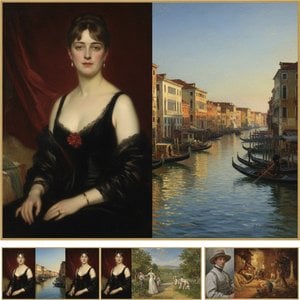
Penelope Carwardine (1729 – 1804): A Delicate Hand in Miniature
Penelope Carwardine, a talented English miniature painter born around 1730 in Withington, Herefordshire, England, was one of eight children born to John Carwardine of Thinghills Court and Anne Bullock of Preston Wynn. Her father’s financial difficulties spurred her artistic pursuits—a resourceful response to circumstance—and she mastered the art of miniature painting under the tutelage of Ozias Humphrey by 1754. This formative training profoundly shaped her distinctive style, aligning her with the modest school of English miniaturists alongside luminaries like Peter Paul Lens and Gervase Spencer.
Early Life and Artistic Training
Penelope’s upbringing instilled in her a deep appreciation for detail and observation—qualities that would become hallmarks of her artistic endeavors. Her family's precarious financial situation necessitated creative solutions, and she skillfully honed her craft through Humphrey’s instruction. Notably, she debuted her miniatures at the Incorporated Society of Artists in London in 1761 and 1762, presenting herself as “Mrs Thomas Carwardine (Anne),” establishing an early foothold within the burgeoning artistic community. Subsequent exhibitions followed in 1771 and 1772, demonstrating a consistent commitment to showcasing her work and engaging with contemporary artistic trends. Humphrey’s guidance wasn't merely technical; it fostered a sensitivity to capturing the inner life of her subjects—a characteristic that would define Carwardine’s oeuvre for decades to come.
Artistic Style and Notable Works
Carwardine’s artistic style was characterized by its exquisite precision and ability to convey emotion through subtle nuances. She belonged to the modest school of English miniaturists—a group distinguished by their dedication to capturing the essence of their subjects—and her oeuvre reflects this ethos. Watercolor served as her favored medium, allowing for luminous colors and delicate textures that perfectly suited the intimate scale of her paintings. Her meticulous attention to detail—evident in every brushstroke—transformed ordinary individuals into portraits imbued with dignity and grace. Among her most celebrated pieces are commissions from Sir Hubert von Herkomer, who documented the lives of working-class individuals with remarkable realism, capturing their expressions and postures with breathtaking accuracy; and portraits of prominent figures like Alexander Eglinton, whose miniature portrait was painted by Joshua Reynolds—a testament to Reynolds’s skill and Carwardine's discerning eye for capturing character. Furthermore, her work found its way into prestigious institutions such as North Ayrshire Heritage Centre, where it continues to inspire admiration for its artistic merit. Her paintings are renowned for their understated elegance and profound psychological insight.
Influences and Connections
Carwardine’s artistic vision was nurtured by connections with fellow artists of her time—particularly Joshua Reynolds and Frances Reynolds—who recognized her talent and encouraged her creative pursuits. Reynolds, a leading figure in the English Rococo movement, championed Carwardine's work and admired her ability to convey emotion through subtle tonal variations. Her friendship with Reynolds extended beyond artistic collaboration; it fostered a shared appreciation for humanist ideals and a commitment to portraying individuals with compassion and understanding. Like many artists of her era, Carwardine drew inspiration from classical art and literature—elements that informed her compositional choices and contributed to the timeless beauty of her miniatures.
Legacy and Continuing Significance
Penelope Carwardine’s legacy extends beyond her individual artworks; she represents an important contribution to the history of English miniature painting. Her meticulous technique and sensitivity to subject matter exemplify the ideals of the Modest School, securing her place as a respected artist within her time. Her portraits—particularly those by Reynolds and Romney—remain treasured examples of eighteenth-century artistry, demonstrating Carwardine’s ability to elevate ordinary individuals into subjects of enduring beauty and grace. Today, Penelope Carwardine's work continues to captivate audiences and inspire artists alike, serving as a poignant reminder of the power of artistic vision and dedication—a testament to her enduring influence on the art world.