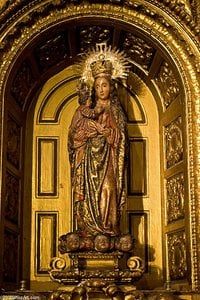
Pedro Roldán: A Seville Sculptor of Baroque Drama
Pedro Roldán, a name synonymous with the vibrant and emotionally charged art of 17th-century Spain, stands as one of the most significant sculptors emerging from Seville during the Baroque period. Born in 1624 amidst the city’s rich artistic heritage, Roldán’s life was inextricably linked to his family's legacy within the sculpting world and profoundly shaped by the influential figures who surrounded him. His career, spanning nearly seven decades, witnessed a remarkable evolution of style, culminating in a distinctive voice that blended naturalism with dramatic intensity – a hallmark of Sevillian Baroque art. His daughter, Luisa Roldán, known as “La Roldana,” further cemented their family’s place within the artistic landscape, continuing and expanding upon her father's innovative approach.Early Life and Artistic Foundations
The precise details surrounding Pedro Roldán’s birth remain somewhat shrouded in historical debate. While traditionally believed to have been born in Antequera or Orce – locations linked to his family’s origins – recent scholarship suggests a birth within Seville itself, aligning with the baptismal records of January 14, 1624, at the Church of the Sanctuary. Regardless of its exact location, Roldán's formative years were spent immersed in the artistic atmosphere of Seville, a city renowned for its skilled sculptors and vibrant religious patronage. His apprenticeship under Alonso de Mena, a master sculptor himself, provided him with a solid foundation in classical techniques and anatomical representation. Mena’s studio offered an environment rich with tradition, yet Roldán quickly demonstrated a burgeoning talent that would soon diverge from established norms. His marriage to Teresa de Jesús Ortega y Villavicencio in 1642, likely a niece of Mena, further solidified his connection to the artistic community and provided him with a stable domestic life as he began building his own reputation.A Studio of Family and Innovation
Roldán’s career truly blossomed after Alonso de Mena's death in 1646. He established his own studio, a bustling center of artistic production that would become a cornerstone of Sevillian Baroque sculpture for decades to come. This wasn’t merely a workshop; it was a family enterprise, with his children and sons-in-law actively participating in the creation of altarpieces, religious figures, and other sculptural commissions. The studio's output extended far beyond Seville’s borders, undertaking projects as diverse as those in Cádiz, Jerez de la Frontera, Córdoba, and Jaén – a testament to Roldán’s growing influence and the demand for his work. Notably, he took on the role of teacher at the Academy of Art founded by Bartolomé Esteban Murillo in 1660, imparting his knowledge and stylistic sensibilities to a new generation of sculptors. This position allowed him to shape the artistic direction of Seville’s burgeoning art scene.Style and Symbolism: From Naturalism to Dramatic Intensity
Initially, Roldán's work reflected a naturalistic approach, mirroring the prevailing trends in Spanish sculpture during his early career. However, as he matured, his style underwent a significant transformation, embracing the dramatic intensity and emotional expressiveness characteristic of Baroque art. His figures are often characterized by dynamic poses, exaggerated gestures, and intensely focused expressions – conveying a profound sense of spirituality and human drama. A key element of his distinctive style was his masterful use of polychrome (the application of color to sculpted surfaces), which brought his works to life with vibrant hues and textures. He skillfully employed techniques to create the illusion of flesh tones, adding depth and realism to his figures. The “St. Michael the Archangel” sculpture, a prime example of this evolution, showcases both his technical skill and his ability to imbue religious subjects with palpable emotion. His work also demonstrates an understanding of symbolism, incorporating elements that conveyed specific theological meanings within the context of the commissioned pieces.Legacy and Enduring Influence
Pedro Roldán died in 1699, leaving behind a substantial body of work that continues to captivate viewers today. His legacy extends beyond his individual creations; he profoundly influenced the artistic development of Seville and shaped the trajectory of Spanish Baroque sculpture. His daughter, Luisa Roldán (“La Roldana”), carried on his family’s tradition, establishing herself as a prominent sculptor in her own right. The Roldán family's studio became synonymous with quality and innovation, contributing significantly to the artistic landscape of Andalusia for generations. Today, works by Pedro Roldán can be found in prestigious collections such as the Hospital de la Caridad in Seville, where his “Virgin of Charity” remains a powerful testament to his skill and artistry. His work stands as a vital link to the rich artistic heritage of Spain, offering a glimpse into the dramatic world of 17th-century Baroque art.Preguntas y respuestas
¿Puedo visitar un museo virtual con las obras de Pedro Roldán?
Puede realizar una visita virtual: la página Galería 3D de Pedro Roldán presenta las obras del artista en una galería tridimensional.
¿Puedo estudiar el uso del color de Pedro Roldán en toda su obra?
El perfil cromático de la obra de Pedro Roldán se puede consultar en su página de ADN de la Paleta.
¿Dónde puedo ver las obras de Pedro Roldán en orden cronológico?
La página de Cronología de obras del artista presenta las obras de Pedro Roldán ordenadas cronológicamente, año tras año.