Early Life and Training
Paulus van der Velden (1837 – 1913), a Dutch artist of Dutch descent, was born in Rotterdam; his parents were Jacoba van Essel and Joannes van der Velden, a warehouse manager. Petrus began drawing lessons at around the age of 13 and subsequently apprenticed as a lithographer. In 1858, he founded a lithographic printing firm in Rotterdam with business partner J. G. Zijderman. He studied at the academies in Rotterdam and Berlin. He registered at the Academy of Art, Rotterdam in 1868. After a stay on the island of Marken (1871–73) he lived in or near The Hague until 1888 and was part of the Hague School in artistic and stylistic origins. During this period he painted mainly genre scenes such as “The Dutch Funeral” (1872; Christchurch, NZ, McDougall A.G.) and “The Old Cellist” (1887; The Hague, Gemeentemus.); he also produced some landscapes, for example “Snow on the Sand Dunes” (1889–90; Wellington, Mus. NZ, Te Papa Tongarewa). His work of this period displays a tension between Naturalism and Romantic Realism in the style of Jozef Israëls.Artistic Career in the Netherlands and New Zealand
Van der Velden’s early work focused on marine studies, a quintessential Dutch genre. As seen in “Snow on the Sand Dunes,” one of his few finished paintings from this period, his style was already showing signs of evolution towards more expressive works. In 1890, van der Velden emigrated to New Zealand with his family, where he continued to paint, often focusing on landscapes and harbor scenes. His work “Sketch of a Sailing Ship No. 1” (now part of the Te Papa Collection in Wellington) demonstrates his skill in capturing the beauty of maritime life. He brought to Christchurch the attitudes and concerns of one of Europe’s most highly regarded artistic centres, and introduced the role of the professional artist. By the end of the 1890s he discovered Otira Gorge on the West Coast, which provided him with his most successful and enduring subject, one that contributed to the revolution of New Zealand painting. The first trip took place in 1891 and the product was “Waterfall in the Otira (aka Mountain Stream)” (1891; Dunedin, NZ, Pub. A.G.). Local legend has it that when van der Velden visited Otira he patiently waited for the weather’s most dramatic moments. Only when thunder, rain and wind were in full chaotic swing would he race up to the Gorge with paints in hand; when sun and calm prevailed he would sleep on the grass in front of the Otira hotel. His teaching method placed emphasis on acquiring an intimate acquaintance with the subject by doing a great many drawings and studies.Notable Works and Legacy
- **“Snow on the Sand Dunes” (Te Papa, Wellington, New Zealand)**: A small, yet powerful study of sand dunes, showcasing van der Velden’s expressive use of paint. - **“Sketch of a Sailing Ship No. 1” (Te Papa, Wellington, New Zealand)**: Demonstrates his ability to capture the beauty of maritime scenes.Museums and Collections Featuring Van Der Velden’s Work
- The Museum Mauritshuis (Netherlands): While not specifically featuring van der Velden's work, it is a significant Dutch art museum that showcases the country's rich artistic heritage. - Rijksdienst beeldende kunst (The Hague, Netherlands): Another notable Dutch museum, its collection reflects the breadth of Dutch art, including works from the golden age.Preguntas y respuestas
¿Puedo explorar las obras de Paulus Van Der Velden por técnica?
Para encontrar todas las obras de Paulus Van Der Velden por técnica, visite la página de Todas las técnicas del artista.
¿Con qué otros nombres o alias se conoce a Paulus Van Der Velden?
Paulus Van Der Velden también es conocido como Petrus Van Der Velden.
¿Dónde puedo visitar el museo virtual en 3D con las obras de Paulus Van Der Velden?
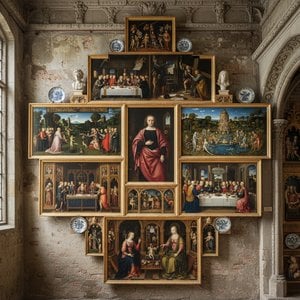
Puede realizar una visita virtual: la página Galería 3D de Paulus Van Der Velden presenta las obras del artista en una galería tridimensional.