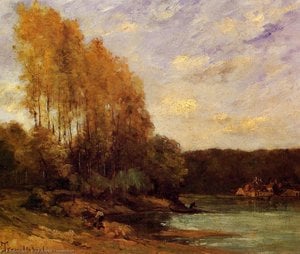
Paul Désiré Trouillebert: Uniendo la Tradición de Barbizon con la Visión Impresionista
Paul Désiré Trouillebert (1829 en París, Francia – 28 de junio de 1900 en París, Francia) se erige como una figura fundamental dentro de la Escuela de Barbizon francesa, un movimiento artístico que defendió la pintura plein air y buscó capturar la esencia de los paisajes rurales con un realismo inquebrantable. Nacido en el seno de una familia burguesa parisina, los primeros años de Trouillebert permanecen relativamente ocultos; sin embargo, su trayectoria artística lo estableció rápidamente como un talentoso observador e intérprete de la grandeza de la naturaleza. Perfeccionó sus habilidades bajo la tutela de Ernest Hébert (1817–1908) y Charles Jalabert (1819–1901), absorbiendo los preceptos estilísticos de sus respectivos enfoques hacia la pintura de paisaje, principios que moldearían profundamente la obra distintiva del propio Trouillebert.- Inicios y Debut en el Salón: Trouillebert debutó en el Salón de 1865, marcando un hito significativo en su carrera artística. Con tan solo 36 años, presentó “A Quiet Backwater”, una pintura de paisaje que obtuvo de inmediato el aplauso de la crítica y presagió su creciente fascinación por capturar las sutileidades atmosféricas. Sus exposiciones posteriores en el Salón consolidaron su reputación como un artista respetado dentro del mundo del arte parisino.
- La Influencia de Corot: Las sensibilidades artísticas de Trouillebert estuvieron innegablemente influenciadas por la técnica de finales de siglo defendida por Jean-François Millet y, crucialmente, Gustave Courbet. Sus paisajes poseen una semejanza palpable con las evocadoras composiciones de Corot —caracterizadas por una luz difusa, tonos suaves y un énfasis en el detalle textural—, demostrando la dedicación de Trouillebert a preservar el espíritu de la tradición de Barbizon.
La Pintura de Paisaje y el Mito de Corot
Los paisajes de Trouillebert trascendieron la mera representación topográfica; su objetivo era transmitir una respuesta emocional profunda ante el mundo natural. Estudió meticulosamente las técnicas de Corot, adoptando sus pinceladas características y paletas de colores para imbuir sus lienzos con una atmósfera de tranquilidad y contemplación. Ólebras como “Path on the Banks of the Seine” ejemplifican esta convergencia estilística, capturando los reflejos trémulos de la luz solar sobre el agua con una precisión notable, un testimonio del compromiso inquebrantable de Trouellebert con la integridad artística. El célebre incidente de la falsificación en torno a “Au bois rossignolet”, donde uno de sus paisajes fue atribuido falsamente a Corot y vendido posteriormente por una suma considerable, subraya el legado perdurable de la obra de Trouillebert y su conexión con el discurso artístico más amplio de la época.- Más allá del Paisaje: Retratos y Exploraciones Orientalistas: Si bien la pintura de paisaje constituía su enfoque principal, Trouillebert poseía una versatilidad considerable como artista. Produjo retratos cautivadores que capturaban con destreza los matices psicológicos de sus sujetos —a menudo representando figuras en entornos íntimos— y se aventuró en temas orientalistas, notablemente con “The Harem Servant Girl”, una impactante representación de una figura femenina desnuda realizada al estilo de la antigüedad grecorromana.
- Logros Notables y Reconocimiento: Las pinturas de Trouillebert alcanzaron un considerable reconocimiento durante su vida y continúan resonando en coleccionistas e historiadores del arte hoy en día. Su trabajo fue exhibido en exposiciones prestigiosas, incluyendo el Salón de París de 1884, donde “The Bathers” recibió críticas favorables.
Un Legado Marcado por la Autenticidad y la Integridad Artística
A pesar de la controversia que rodeó la falsificación de Corot —un intento deliberado de inflar el valor del arte de Trouillebert—, su reputación artística descansa firmemente sobre la base de una innovación genuina y una adhesión inquebrantable a los principios de Barbizon. La capacidad de Trouillebert para destilar la belleza sublime de los paisajes rurales en pinturas poderosamente expresivas consolidó su lugar como un contribuyente significativo al impresionismo francés, aunque fuera uno que permaneció fielmente arraigado en la tradición. Su influencia perdurable puede discernirse en las generaciones posteriores de paisajistas que buscaron emular su dominio magistral del color y la textura, un testimonio de la contribución duradera de Trouillebert a la historia del arte.Preguntas y respuestas
¿Cómo puedo ver todas las obras de Paul Trouillebert?
Puede explorar todas las obras de Paul Trouillebert en este sitio web desde la página de Todas las obras de arte del artista.
¿Puedo ordenar las obras de Paul Trouillebert por color?
El Índice de color de Paul Trouillebert organiza las obras del artista por colores.
¿Puedo visitar un museo virtual con las obras de Paul Trouillebert?
Las obras de Paul Trouillebert pueden verse en una galería 3D en la página Galería 3D del artista.