Pablo Bronstein: Architect of Illusion
Pablo Bronstein (born 1977, Buenos Aires) is an Argentine artist currently residing in London, where he continues to push the boundaries of artistic expression through a distinctive blend of architectural drawing and performance art. His formative years were spent honing his craft at Central Saint Martin’s College of Art and Design and the Slade School of Fine Art at UCL, culminating in a degree from Goldsmiths College of Art – institutions renowned for fostering innovation and challenging conventional approaches to visual arts.
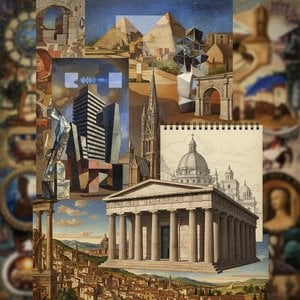
Bronstein's artistic practice centers around meticulously rendered architectural sketches executed primarily in ink and gouache. These drawings aren’t merely representations of buildings; they are elaborate constructions imbued with an aesthetic rooted in the grandeur of eighteenth-century France, juxtaposed against the vibrant energy of the 1980s. He deliberately incorporates stylistic elements from both eras—the ornate detailing characteristic of Baroque palaces alongside geometric patterns reminiscent of Memphis design—creating a visual dialogue that speaks to broader cultural currents. The resulting images are framed within ornate frames, enhancing their impact and emphasizing the artist’s fascination with materiality and illusion. This technique reflects his deep understanding of artistic history and his desire to provoke contemplation about how past styles can inform present interpretations.
Beyond his drawings, Bronstein distinguishes himself through immersive performance pieces. Notably, “Plaza Minuet” for Tate Triennial 2006 captivated audiences as dancers choreographed movement across the gallery space, mirroring the rhythmic patterns of Baroque dance. This ambitious undertaking underscored Bronstein's commitment to exploring artistic concepts within real-world contexts and engaging viewers in a dynamic interaction with art. He sought to disrupt traditional notions of viewing experience, prompting participants to consider how spatial arrangement influences perception and emotional response. Furthermore, he undertook an architectural tour of London, demonstrating his deep understanding of urban spaces and their influence on creative thought—a journey that fueled his artistic vision and solidified his belief in the importance of confronting the physical environment as a catalyst for imaginative exploration.
Influenced by artists such as Giorgio Morandi and Eduardo Chillida, Bronstein’s work embodies a quiet contemplation of form and space, mirroring the minimalist aesthetic championed by Morandi and the sculptural precision characteristic of Chillida. These influences underscore his commitment to distilling artistic ideas into their purest expressions—a stylistic hallmark that distinguishes him from many contemporary artists. His exploration of architectural forms serves as a conduit for investigating broader questions about perception, memory, and the relationship between art and environment.
Bronstein’s artistic achievements extend beyond individual projects; he has garnered recognition for his conceptual rigor and his ability to transform seemingly simple mediums into vehicles for complex ideas. He is considered a significant voice within contemporary art discourse, contributing to ongoing conversations about how artists can engage with history and culture while forging new paths forward. His work continues to inspire admiration for its meticulous craftsmanship and its profound engagement with artistic tradition—a legacy that cements his place as one of Argentina’s most distinctive visual artists.