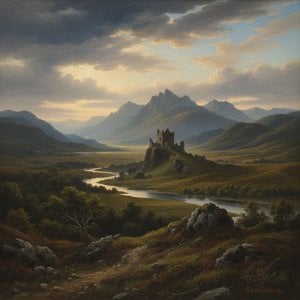
Otto Theodor Leyde: A Scottish Painter of Shadows and Light
Otto Theodor Leyde (1835-1897) wasn’t a name that immediately resonates within the grand halls of art history, yet his canvases hold a quiet power—a melancholic beauty deeply rooted in the landscapes and lives of Scotland. Born in Wehlau, Prussia – now part of Poland – Leyde's journey led him to Edinburgh, where he established himself as a significant figure in the Scottish art scene, particularly within the Royal Scottish Academy. His work wasn’t characterized by flamboyant displays or revolutionary techniques; instead, it offered intimate glimpses into rural life, evocative portraits, and meticulously rendered scenes that captured the essence of his adopted homeland with remarkable sensitivity. Leyde's legacy lies not in grand pronouncements but in a subtle, persistent voice—a painter who understood how to imbue ordinary moments with an extraordinary sense of atmosphere.Early Life and Artistic Training
Leyde’s early life remains somewhat shrouded in the mists of historical record, though it's known he received his initial artistic training under Professor Rossenfelder at the Royal Academy of Fine Arts in Königsberg (Kaliningrad). This foundation provided him with a solid grounding in traditional techniques and academic principles. Crucially, however, Leyde’s artistic development wasn’t solely dictated by formal instruction. He possessed an innate observational skill, honed through years spent traveling and immersing himself in the diverse landscapes of Europe. His family history – tracing back to Prussia – likely contributed to a certain sense of displacement and perhaps a yearning for connection that subtly informed his work. Moving to Edinburgh in 1854 marked a pivotal moment, establishing him within a thriving artistic community and providing access to new subjects and inspirations.Themes and Style: Scotland’s Soul
Leyde's oeuvre is dominated by two primary themes: the Scottish landscape and portraiture. His depictions of the Highlands and Lowlands are not romanticized vistas but rather honest portrayals of rural life—the weathered faces of farmers, the quiet dignity of shepherds tending their flocks, and the stark beauty of moorland and lochside. He frequently employed a muted palette – predominantly browns, greys, and greens – to create a sense of atmospheric depth and subtly convey the changing seasons. His brushwork was deliberate and controlled, prioritizing detail and texture over dramatic effects. This meticulous approach is particularly evident in works like “The Blacksmith’s Shop,” where he captures not just the physical appearance of the scene but also the palpable atmosphere of industry and family life. Portraits were another significant part of his output; he possessed a remarkable ability to capture the character and inner lives of his subjects, often imbuing them with a sense of quiet contemplation or melancholy. His portrait of Sir Thomas Boyd exemplifies this skill, presenting an aged gentleman not as a mere likeness but as a figure imbued with wisdom and experience.Key Works and Recognition
Among Leyde’s most celebrated works is “Auld Robin Gray,” a hauntingly beautiful depiction of a solitary robin perched on a branch – a symbol of resilience and the passage of time. This piece, along with his numerous landscape studies and portraits, gained him recognition within the Royal Scottish Academy, where he was elected in 1880. His work frequently appeared alongside that of other prominent Scottish artists like Sir Thomas Butler and Robert Ford. His etching of James Clarke Hook, a fellow artist and Liberal politician, is another notable example of his skill in capturing personality and character. Leyde’s artistic output also included prints and illustrations for publications, further expanding his visibility and influence. The Metropolitan Museum of Art holds one of his works, demonstrating the international recognition he received during his lifetime.Legacy and Historical Significance
Otto Theodor Leyde's contribution to Scottish art is often understated but profoundly significant. He wasn’t a revolutionary innovator, but rather a skilled observer and interpreter of his surroundings. His paintings offer a valuable window into the lives and landscapes of 19th-century Scotland—a period of profound social and economic change. His work reflects a deep appreciation for the beauty of the natural world and a sensitivity to the human condition. Leyde’s quiet, evocative style continues to resonate with viewers today, reminding us of the power of art to capture not just what we see but also what we feel—the subtle emotions and enduring truths that lie beneath the surface of everyday life. He remains a testament to the fact that true artistic greatness often resides in the ability to quietly and powerfully convey the essence of a place and its people.Preguntas y respuestas
¿En qué periodo histórico trabajó Otto Theodor Leyde?
Otto Theodor Leyde trabajó durante el periodo 19th Century. Este periodo sitúa la actividad del artista en la historia.
¿Dónde puedo ver las obras de Otto Theodor Leyde organizadas por atmósfera?
La Galería de estados de ánimo de Otto Theodor Leyde es una página que organiza las obras del artista según el estado de ánimo.
¿Dónde se encuentran las obras de Otto Theodor Leyde agrupadas por paleta?
Para encontrar obras de Otto Theodor Leyde en una paleta específica, utilice la página de Por paletas de colores del artista.