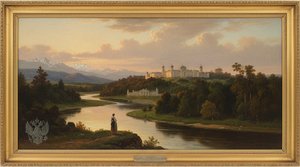
Nikanor Grigorievich Chernetsov: A Visionary of Russian Landscape
Nikanor Grigorievich Chernetsov (1805 – June 8, 1865) stands as a cornerstone of Russian landscape painting during the Romantic era, revered for his unparalleled dedication to detail and his ability to infuse his canvases with profound emotional resonance. Born in Lukh, Russia, Chernetsov’s artistic journey commenced with a rigorous education at the Imperial Academy of Arts in Saint Petersburg under Maxim Vorobiev from 1823 to 1827 – an institution that instilled within him the core tenets of Romanticism and championed realism alongside expressive color palettes. This formative influence would indelibly shape his distinctive style, characterized by meticulous observation and a palpable connection to the sublime beauty of Russia’s natural world.
Early Life & Influences: The Seeds of Romantic Vision
Vorobiev’s Impact: Maxim Vorobiev's pedagogical approach prioritized capturing atmospheric conditions—the interplay of light and shadow—and conveying psychological depth—the inner landscape mirrored in external vistas. This emphasis on emotional resonance would become a defining characteristic of Chernetsov’s artistic output, guiding his selection of subjects and informing his compositional choices. He believed that art should aspire to capture not merely what the eye perceives but also what the soul feels.
Family Legacy: Chernetsov descended from a family rooted in modest means, fostering an inherent appreciation for simplicity and authenticity—values that profoundly resonated with his artistic sensibilities. This upbringing instilled within him a sensitivity to human experience and a desire to portray it truthfully, shaping his worldview and informing his artistic endeavors.
Travels & Sketching: Mapping Russia’s Soul
Extensive Explorations: Chernetsov undertook ambitious expeditions throughout Russia, traversing the rugged Caucasus Mountains, the serene shores of Crimea, and venturing into the Middle East—experiences that served as invaluable training grounds for honing his sketching skills. These journeys weren't merely quests for picturesque landscapes; they were immersive investigations into the spirit of the Russian people and their relationship with the environment. His sketches became the bedrock upon which he built his monumental paintings, capturing fleeting moments of beauty and grandeur.
Kazbek Mountain: Chernetsov’s depiction of Kazbek exemplifies his unwavering commitment to meticulously documenting geological formations and atmospheric subtleties. The imposing peak dominates the canvas, rendered with breathtaking accuracy—a testament to his observational prowess and a reflection of Romantic fascination with sublime grandeur. He sought to convey not just the physical appearance of Kazbek but also its aura of majesty and power.
The Volga River: Chernetsov’s series on the Volga River showcases his mastery in portraying the tranquil beauty of Russian waterways under varying weather conditions. Subtle tonal gradations evoke the serenity of calm days, while dramatic brushstrokes capture the turbulence of storms—demonstrating his ability to translate atmospheric phenomena into compelling visual narratives.
Technique & Style: Layers of Light and Emotion
Glazing Mastery: Chernetsov’s distinctive technique involved layering glazes—a painstaking process that demanded patience and precision—allowing him to achieve luminous colors and subtle textural variations. This meticulous approach elevated his paintings beyond mere representation, imbuing them with depth and luminosity that captivated audiences. He understood that color itself could convey emotion—that hues could evoke feelings of joy, sorrow, or awe.
Atmospheric Rendering: Chernetsov expertly depicted atmospheric conditions, mirroring the Romantic preoccupation with capturing mood and emotion. He meticulously studied how light interacted with surfaces, striving to reproduce faithfully the nuances of natural illumination—a skill honed through years of observation and experimentation. This dedication to realism combined seamlessly with expressive color palettes, resulting in images that resonated deeply with viewers.
Notable Works: Chernetsov’s oeuvre includes iconic paintings such as “View on Lagoon of Venice,” “Nevka by the Elagin Island,” and “Calm Before The Storm.” Each piece embodies his artistic vision—a testament to his enduring legacy as a master of Romantic landscape art. His works reside in museums across Russia, ensuring that his breathtaking depictions of Russian scenery continue to inspire admiration for generations to come.
Historical Significance & Legacy
Recognition & Influence: Chernetsov’s work gained considerable acclaim within Russia’s artistic circles and secured its place among the foremost Romantic painters of his time—a painter who successfully blended scientific observation with artistic expression, resulting in images that transcend mere visual beauty and communicate profound emotional truths. He served as a teacher at Saint Petersburg Academy of Arts, nurturing the talents of aspiring artists and shaping the trajectory of Russian landscape painting for decades to come. Chernetsov’s enduring influence can be seen in the works of subsequent generations of painters—a testament to his unwavering dedication to artistic excellence and his profound connection to the spirit of Russia's Romantic heritage.