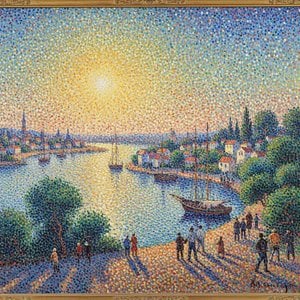
Miloš Jiránek: A Prague Visionary
Born November 19th, 1875, in Lužec nad Vltavou, Miloš Jiránek (1875 – 1911) stands as a singular figure in Czech Neo-Impressionist art, remembered primarily for his captivating depictions of Prague and its environs. His lineage was noble—his father a landowner and his mother possessing considerable wealth originating from peasant roots—providing him with an uncommon educational foundation that fostered intellectual curiosity and linguistic proficiency. This formative period was marked by tutelage under Jaroslav vrchlický, where he absorbed a vast literary landscape, cultivating a lifelong passion for reading in its original form. This early exposure profoundly shaped his artistic sensibilities.
His academic pursuits culminated in studies at Charles University’s Faculty of Arts (1894), followed by enrollment at the Academy of Fine Arts in Prague (1895), where he honed his craft under the guidance of Maximilian Pirner and Vojtěch Hynais. Recognizing the importance of artistic collaboration, he joined the Mánes Union of Fine Arts in 1897, immersing himself within a vibrant intellectual milieu dedicated to elevating Czech art. This union fostered connections with fellow artists and thinkers who championed innovative ideas—a crucial element in shaping Jiránek’s artistic worldview.
A pivotal journey to Munich, Venice, and Trieste in 1900 exposed him to European artistic currents, notably Auguste Rodin’s monumental sculptures—an encounter that would indelibly influence his own approach to form and expression. He championed the introduction of Rodin's work into Prague society, alongside Edvard Munch’s unsettling visions, establishing himself as a crucial conduit for disseminating avant-garde concepts. This fascination with sculptural forms translated into meticulous detail in his paintings, mirroring Rodin’s emphasis on capturing emotion and physicality.
Further enriching his artistic repertoire was a three-year expedition to Slovakia (1905), during which he undertook a monumental project—a series of paintings capturing the majesty of the Tatra Mountains—demonstrating both technical mastery and an unwavering commitment to portraying the natural world with uncompromising realism. These landscapes weren’t merely representations; they were imbued with a palpable sense of atmosphere, reflecting Jiránek's dedication to conveying nuanced emotional responses to his subjects. His meticulous observation skills ensured that every brushstroke conveyed a profound connection to the environment.
His marriage to Antonína Zedniková in 1905 brought him into contact with another influential artist, fostering a shared aesthetic vision centered on unconventional perspectives of Prague Castle. This period witnessed Jiránek’s exploration of architectural nuances and atmospheric subtleties, reflecting his meticulous observation skills. Despite facing personal challenges—including a debilitating nervous breakdown in 1910—he continued to produce artwork until his untimely death on November 2nd, 1911, at just 36 years old. He was buried in Olšany Cemetery, Prague—a testament to a life dedicated to artistic creation and intellectual pursuit. Miloš Jiránek’s legacy resides not merely in his paintings but also in his role as a fervent advocate for modern art and a perceptive chronicler of Prague's cultural landscape, securing his place among the most significant figures of Czech Neo-Impressionism.