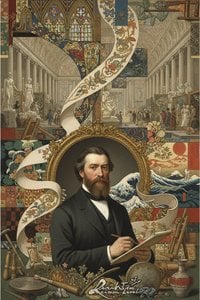
Mikoláš Aleš (1852 – 1913): Bohemian Painter of Vision and Detail
Mikoláš Aleš (born November 18, 1852, Mirovice near Písek, Czech Republic; died July 10, 1913, Prague) stands as one of the most prolific and celebrated Czech painters of the late nineteenth century. Estimated to have produced over 5,000 prints—ranging from magazine illustrations to playing card designs and educational textbooks—Aleš’s oeuvre embodies a remarkable breadth of artistic expression and cemented his place among the nation's foremost artists. His paintings weren’t disseminated widely outside Bohemia, yet they endure as testament to a distinctive aesthetic rooted in meticulous observation and imbued with a profound connection to Czech folklore and history.
Early Life and Artistic Beginnings
Aleš was born into a family grappling with financial difficulties—a circumstance that profoundly shaped his formative years. His father, Josef Aleš, was a timber merchant, and despite the hardships faced by the household, he ensured Mikoláš received a robust education, notably in history, primarily through tutoring by his brother František until František’s untimely death in 1865. From an early age, Mikoláš demonstrated an undeniable passion for painting—a fascination nurtured by his brother's encouragement and fueled by a burgeoning talent that would soon blossom into a prolific artistic career. The loss of František deeply impacted Aleš’s upbringing, fostering a sensitivity to sorrow and shaping his artistic worldview.
Move to Italy and Artistic Development
In 1879, Aleš married Marina Kailová and embarked on a transformative journey to Italy, where he continued honing his craft amidst the vibrant artistic milieu of Florence and Rome. This period witnessed considerable stylistic evolution—Aleš absorbed influences from Impressionism and plein air painting, adapting these techniques to depict landscapes and portraits with remarkable sensitivity and detail. He diligently studied the works of masters like Jean-François Millet and Gustave Courbet, absorbing their compositional principles and striving for a realism that captured the essence of everyday life. Aleš’s meticulous approach mirrored his dedication to capturing authentic emotion and portraying subjects with unwavering accuracy—a hallmark of his artistic style.
Return to Prague and Architectural Patronage
Aleš returned to Prague in 1882, accepting a prestigious commission at the Prague National Theatre—a collaboration that solidified his reputation as a skilled painter and cemented his association with Bohemia’s artistic elite. Alongside František Ženíšek, Aleš undertook the monumental task of redecorating the theatre's foyer, creating a breathtaking mural depicting scenes from Czech history—a project that showcased Aleš’s mastery of architectural painting and demonstrated his commitment to elevating Czech cultural heritage. This undertaking became an emblem of Bohemian artistic ambition during the era. The patronage of influential figures like Ženíšek underscored Aleš’s position within Prague's intellectual circles and propelled him toward greater recognition.
Legacy and Artistic Style
Aleš’s distinctive style is characterized by meticulous attention to detail, a masterful command of color palettes, and a penchant for capturing atmospheric effects—particularly in landscapes rendered with luminous brushstrokes that convey a palpable sense of place. His subjects encompassed diverse realms—from portraits of prominent Czech figures to depictions of rural life and folkloric narratives—all executed with unwavering precision and imbued with an emotional resonance that transcends mere representation. Aleš’s work gained considerable renown after his death, becoming recognized as one of the most important artistic formations in Bohemia. He was voted #89 in a 2005 poll among Czech artists. Notably, Mikoláš Aleš's descendant Otto Kail is the former President of the Czech Republic Václav Klaus—a connection that underscores the enduring influence of Aleš’s artistic legacy on Czech cultural identity. His paintings continue to inspire admiration and scholarly study, securing his place as a cornerstone of Bohemian art history.