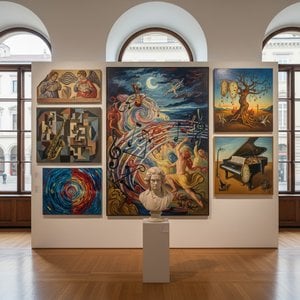
Barbican Music Library Collaborations: Exploring Light, Sound and Space Through Melanie Reinisch’s Vision
Melanie Reinisch's artistic practice is inextricably linked to the Barbican Music Library, a monumental cultural institution situated in London’s East End. More than simply providing a backdrop for musical performances and archives—a role it fulfills with distinction—the library serves as an impetus for Reinisch’s investigations into sensory experience; specifically how light and sound intertwine to sculpt perception and forge immersive environments. Her collaborations with this singular space represent a remarkable convergence of art and music, resulting in installations that transcend conventional artistic boundaries and invite viewers to reconsider their connection with sonic landscapes—a perspective profoundly shaped by the principles of psychoacoustics.
Reinisch’s artistic genesis unfolded in Germany, where she cultivated her sculptural prowess and honed her understanding of installation art, prioritizing materials like wood and metal. These elements weren't merely utilized; they were deliberately repurposed or transformed into sculptural forms that mirrored the rhythmic cadence of musical compositions—a testament to Reinisch’s unwavering dedication to translating auditory vibrations into tangible visual representations. Influenced by composers such as Tangerine Dream and Brian Eno – figures who championed experimental music and embraced environmental responsiveness – her work embodies a spirit of fearless exploration and intellectual curiosity. Their pioneering approaches to sound design profoundly impacted Reinisch's artistic sensibilities, fostering an appreciation for sonic textures and harmonies that permeate her oeuvre.
A pivotal partnership materialized with Tangerine Dream, whose seminal album “Zeitraffer” functioned as the cornerstone of inspiration for a breathtaking installation housed within the Barbican Music Library. The centerpiece was a VCS 3 analog synthesizer by Electronic Music Studios—a meticulously positioned instrument designed to generate soundscapes mirroring the very essence of the music itself. Reinisch’s artistic vision extended beyond this singular instrument; she incorporated a Mini Moog, enriching the sonic tapestry and demonstrating her unwavering commitment to capturing musical expression in tangible form. These installations weren't merely reproductions; they were active dialogues between art and music—a deliberate challenge to traditional notions of representation that prompted visitors to contemplate how sound shapes our comprehension of space and visual perception. Reinisch’s meticulous attention to detail ensured that every element contributed to a holistic sensory experience, reflecting the profound interconnectedness between artistic mediums.
Reinisch's artistic explorations have traversed continents, garnering critical acclaim for her conceptual rigor and aesthetic elegance. She consistently seeks to disrupt established paradigms of artistic representation, prioritizing sensory engagement over literal depiction—a characteristic that resonates deeply with the Barbican Music Library’s core mission: to nurture creativity and propel innovation within the arts community. Through her immersive installations and sculptural explorations, Melanie Reinisch has solidified her position as a significant voice in contemporary art, illuminating how artistic practice can unlock the latent potential of human consciousness and fostering a deeper appreciation for the transformative power of sensory perception.
- Notable Exhibitions: Galerie Neu Ulm
- Key Themes: Sensory Perception, Psychoacoustics, Spatial Resonance, Material Transformation
- Materials Used: Wood, Metal, Analog Synthesizers (VCS 3), Mini Moog
Influences and Artistic Style
Reinisch’s artistic style is characterized by a deliberate fusion of sculptural technique with the principles of psychoacoustics—a methodological approach that underscores her conviction in harnessing scientific understanding to elevate aesthetic beauty. Her formative years were marked by immersion in German art academies, where she mastered sculpting methods and gained invaluable insight into material manipulation. This foundational knowledge informs her ongoing practice, resulting in artworks that possess both structural integrity and a palpable responsiveness to environmental stimuli—a hallmark of her distinctive artistic vision. The influence of composers like Tangerine Dream and Brian Eno is undeniable; their pioneering explorations of ambient music and sonic landscapes served as catalysts for Reinisch’s conceptual breakthroughs, shaping her aesthetic sensibilities and propelling her toward groundbreaking innovations in spatial art.
Major Achievements
Reinisch's artistic accomplishments have garnered international recognition—a testament to her unwavering dedication to pushing creative boundaries and redefining the role of art within broader cultural contexts. Her installations have been showcased at prestigious venues across Europe, captivating audiences with their intellectual depth and emotional resonance. Critiques consistently praise Reinisch’s ability to synthesize disparate disciplines—combining sculptural artistry with psychoacoustic research—demonstrating her mastery of complex artistic methodologies. Furthermore, her collaborative projects with institutions like the Barbican Music Library underscore her commitment to fostering dialogue between art and science, furthering the advancement of sensory perception studies and enriching the cultural landscape.
Historical Significance
Melanie Reinisch stands as a pivotal figure in the evolution of contemporary art—a trailblazer who championed immersive experiences and challenged conventional artistic representations. Her work embodies a profound reimagining of how artists engage with their surroundings, prioritizing sensory perception over literal depiction—a paradigm shift that anticipates future trends within the visual arts. By integrating psychoacoustic principles into her sculptural practice, Reinisch elevated artistic exploration beyond mere aesthetic contemplation, prompting viewers to contemplate the intricate connections between sound, light, and human consciousness—a legacy destined to inspire generations of artists to come.