María Loboda: Sculpting Memory and Embracing the Sublime
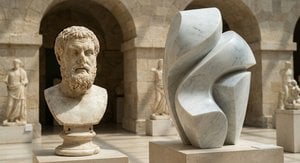
Maria Loboda, born in Warsaw, Poland, in 1979, is a sculptor whose work delves into profound explorations of transformation, memory, and the intricate relationship between humanity and the natural world. Her artistic journey began with studies at Warsaw University’s Academy of Fine Arts and continued at the Royal College of Art in London, equipping her with a robust foundation in both conceptual art and sculptural technique. Loboda's distinctive style is characterized by monumental wooden sculptures that juxtapose organic forms—often reminiscent of weathered landscapes—with minimalist settings, creating striking visual dialogues. This approach immediately establishes a tension between solidity and vulnerability, mirroring the artist’s preoccupation with confronting existential questions.
Loboda’s artistic vision finds its roots in a fascination with mythology and folklore, particularly the symbolism surrounding sacred spaces and rituals. She draws inspiration from ancient traditions—considerations of Celtic spirals and Mesopotamian ziggurats—and seeks to capture the essence of timeless narratives within her sculptures. This influence manifests itself in her meticulous attention to detail—from the grain of the wood to the subtle contours of the forms—reflecting a deep respect for material qualities and their capacity to convey emotional resonance. Loboda’s work isn't merely about representing objects; it’s about evoking feelings, prompting contemplation, and inviting viewers to consider questions of existence and perception. The artist herself describes her process as “a dialogue with time,” striving to imbue each piece with a sense of permanence while acknowledging the ephemeral nature of experience.
Her exhibitions have spanned continents, showcasing her talent in prestigious venues like Documenta XIII in Kassel, Germany, and The Power Plant Contemporary Art Gallery in Toronto, Canada. These presentations underscore Loboda’s commitment to engaging with broader artistic discourse and fostering dialogue about contemporary themes—themes that often grapple with notions of environmental responsibility and the legacy of cultural heritage. Critics have lauded her ability to transform raw materials into evocative artworks that resonate with viewers on a visceral level, recognizing her sculptures as powerful statements about our connection to the earth. Notably, Loboda’s work has been compared to the monumental sculptures of Auguste Rodin, demonstrating an understanding of sculptural tradition and its capacity for conveying profound emotion.
Loboda’s sculptural practice is underpinned by an unwavering dedication to experimentation—she constantly pushes boundaries and seeks new ways to express complex ideas through form and texture. Her exploration of natural elements – particularly wood – speaks to a broader concern for sustainability and the importance of honoring the heritage of craftsmanship. Loboda's sculptures stand as testament to her belief that art can serve as a conduit for understanding our place within the universe, prompting us to confront both beauty and darkness with equal measure. She utilizes techniques honed over years of practice, blending subtractive carving with additive assemblage—a deliberate contrast reflecting the artist’s desire to capture the multifaceted nature of reality.
Currently residing and working in Berlin, Germany, Maria Loboda continues to refine her artistic vision and contribute to the vibrant cultural landscape of Europe. Her enduring legacy lies not only in her impressive body of work but also in her unwavering commitment to artistic integrity—a quality that ensures her sculptures will continue to inspire generations to come.