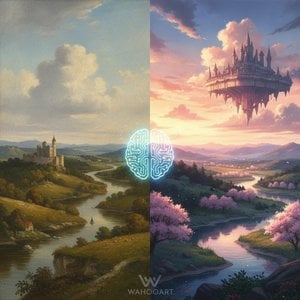
Museums on APS: Meiji Jingu Forest Festival de Arte
Born: 1975, Kanagawa, Japón
A Bridge Between Tradition and Innovation: Exploring the Art of mami kosemura
mami kosemura’s artistic journey began in Kanagawa, Japan, where she was born in 1975. From a young age, her fascination with visual storytelling propelled her into both photography and animation—disciplines that wouldn't simply coexist but actively intertwine, creating artworks that transcend conventional boundaries. Her formative years were marked by an immersion in classical European motifs alongside the rich tapestry of Japanese painting traditions. This dual influence is palpable throughout her oeuvre, demonstrating a deliberate effort to honor heritage while simultaneously forging new paths forward.
Early Photography: Kosemura’s initial photographic explorations focused on capturing ethereal landscapes and portraits—subjects often imbued with symbolic resonance reminiscent of Romanticism and Impressionism. She skillfully employs light and shadow, mirroring techniques found in Japanese ink wash paintings (sumi-e), to convey mood and emotion. Her images resonate with the contemplative spirit of Zen Buddhism, reflecting a profound understanding of how visual elements can communicate intangible concepts—a hallmark of her artistic sensibility.
Animation as Conceptual Framework: Recognizing the power of movement and narrative, Kosemura transitioned into animation, utilizing it not merely as a medium but as a conceptual tool. Her animations delve into themes of memory, perception, and the relationship between observer and observed—concepts explored extensively in Zen Buddhism and Japanese aesthetics. She sees animation as a way to explore the ephemeral nature of reality, mirroring the Buddhist notion of impermanence. This approach distinguishes her work from more straightforward visual representations, elevating it to a level of intellectual engagement that challenges viewers to contemplate deeper philosophical questions.
Her artistic development gained momentum through international exhibitions at institutions like the Hara Museum in Tokyo and Dillon + Lee Gallery in New York. These venues provided invaluable exposure to a global audience and solidified her reputation as a visionary artist committed to pushing creative boundaries. Notably, she founded AhmadyArts and established Asia Contemporary Art Week (ACAW) since 2006—initiatives that champion emerging artists from across the Asian continent and contribute significantly to fostering dialogue within the art world. These endeavors underscore her dedication to supporting artistic innovation and promoting cultural understanding on a global scale.
Key Achievements:
Recognition for Innovative Approaches
International Presence
Promoting Asian Art
Historical Significance: Kosemura’s approach represents a compelling synthesis of Eastern and Western artistic traditions—a deliberate rejection of stylistic homogenization. By referencing classical imagery while simultaneously embracing the dynamism of animation, she speaks to anxieties about cultural identity in an increasingly interconnected world. Her work serves as a reminder that true creativity lies not in imitation but in reimagining established forms with fresh eyes, ensuring that artistic legacies endure and inspire future generations.
Her oeuvre is characterized by a meticulous attention to detail—a characteristic inherited from her training in painting—combined with the experimental spirit of digital media. She consistently seeks to disrupt conventional perceptions of art, prompting viewers to reconsider their assumptions about representation and experience. Through her exploration of themes like memory and perception, Kosemura’s work engages with fundamental questions concerning consciousness and reality—questions that resonate deeply within the philosophical traditions of Japan and Europe alike. Ultimately, mami kosemura's artistic vision embodies a profound respect for both heritage and innovation—a testament to her enduring contribution to contemporary art.
Explore the profound evolution of contemporary photography through a connoisseur's lens. From monochrome mastery to digital innovation, discover how modern photographic works shape fine art collections and define our cultural legacy.
Transforme sus fotos favoritas en legendarias obras maestras de anime con la técnica clásica del óleo sobre lienzo. En WahooArt, nuestros maestros artistas recrean su esencia con pinceladas reales y calidad de museo para crear un legado eterno en su hogar. Calidad garantizada.
Explore the profound artistry of black and white photography. From historical mastery to the interplay of light and shadow, discover how monochrome captures timeless emotion and form through a sophisticated lens of art history.
¡Hola! Puedo ayudarte a elegir una obra de arte, realizar el seguimiento de un pedido o resolver tus dudas sobre la garantía. ¿En qué puedo ayudarte hoy?