Majid Nassery: Exploring Layers of Iranian Identity Through Abstract Expression
Majid Nassery, born in Tehran, Iran in 1955, stands as a prominent figure within contemporary Iranian art. His artistic journey began amidst the vibrant cultural landscape of his homeland, shaping his perspective and informing his distinctive approach to abstraction—a realm where form and color converge to convey profound emotional resonance and intellectual contemplation. While biographical details remain relatively sparse beyond confirmed birthdate, Nassery’s dedication to visual storytelling has garnered considerable acclaim both domestically and internationally.
His formative years were steeped in Iranian artistic traditions, particularly calligraphy and miniature painting—disciplines that prioritize meticulous detail and symbolic representation. These influences subtly permeate his canvases, fostering a sensitivity to texture and layering that distinguishes his oeuvre. He absorbed the precision of Persian script and the intricate narratives woven into traditional miniatures, recognizing how these practices instilled within him an appreciation for careful observation and deliberate composition.
His formal training encompassed studies at Tehran University’s Fine Arts Faculty, providing him with foundational knowledge of artistic principles and techniques. However, Nassery swiftly transcended academic boundaries, embracing experimentation and forging a path toward an intensely personal style characterized by bold color palettes and dynamic compositions. He actively sought inspiration from movements like Abstract Expressionism—particularly the work of Willem de Kooning and Jackson Pollock—recognizing their capacity to communicate raw emotion and challenge conventional notions of representation. This pivotal encounter with American abstract art profoundly impacted his artistic vision, prompting him to abandon representational constraints in favor of expressive gestures and spontaneous color combinations.
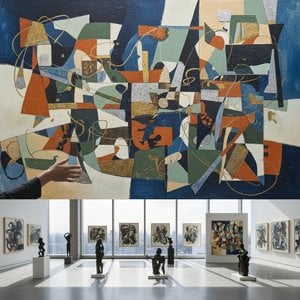
Nassery’s artistic signature lies in his masterful manipulation of pigment and texture. He employs a technique known as “dripping” or “pouring,” mirroring Pollock's method, to achieve spontaneous effects that imbue his paintings with an energy reminiscent of turbulent landscapes—a deliberate reflection of Iran’s dramatic topography and its history marked by upheaval and resilience. Recurring themes within Nassery’s work revolve around notions of identity—both individual and collective—and the complexities inherent in navigating cultural heritage amidst globalization. He explores these concepts through evocative imagery that resists literal interpretation, inviting viewers to engage in a dialogue about memory, perception, and the enduring power of visual language. His canvases pulsate with vibrant hues and textured surfaces, conveying not merely what is seen but what is felt—a testament to his belief that art possesses the capacity to transcend mere depiction and communicate deeper truths about human experience.
Nassery’s artistic achievements have been recognized through numerous exhibitions across Iran and abroad. His pieces have graced galleries in Tehran, Shiraz, and Dubai, showcasing his versatility and establishing him as a respected voice within the Iranian art scene. Furthermore, he has participated in international biennales—demonstrating his commitment to engaging with broader artistic dialogues and fostering cross-cultural understanding. He continues to refine his technique and explore new conceptual territories, ensuring that his distinctive vision remains relevant and inspiring for generations to come. His unwavering dedication to pushing creative boundaries underscores the significance of Iranian art within the global context – a legacy built upon innovation, introspection, and an enduring fascination with the expressive potential of color and form.