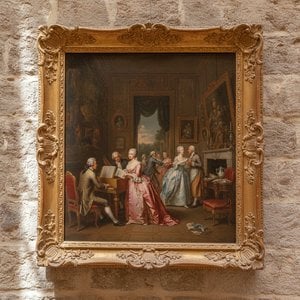
Louis Antoine Capdevielle: A Painter Rooted in Lourdes and Luminosity
Louis Antoine Capdevielle (1849-1905) emerged from the Basque quarries of Sainte-Marie-de-Lourdes, France, a landscape profoundly shaped by faith and artistic ambition. His life’s trajectory intertwined with the burgeoning Impressionist movement while simultaneously anchoring him to the traditions of genre painting—a duality that defines his distinctive oeuvre. Born into modest circumstances, Capdevielle's early fascination with drawing foreshadowed his future vocation as an artist, nurtured initially by local instruction before formal training at the École Nationale Supérieure des Beaux-Arts in Paris solidified his artistic grounding. The mentorship of Alexandre Cabanel and Léon Bonnat further honed his skills, exposing him to academic ideals yet subtly encouraging experimentation—a delicate balance that would characterize his entire career.
Early Influences & Training: Capdevielle’s formative years were marked by the influence of Auguste Millet, a celebrated landscape painter who instilled in him an appreciation for capturing the essence of rural life and conveying emotion through color and light. This connection to Millet's aesthetic sensibilities would prove crucial in shaping his artistic vision.
Military Service & Artistic Development: Despite neglecting the draft lottery during the Franco-Prussian War, Capdevielle served honorably in the Armée de la Loire, gaining invaluable experience observing and documenting the realities of wartime. This period undoubtedly broadened his perspective and deepened his understanding of human emotion—themes he would revisit repeatedly throughout his artistic output.
The Lourdes Connection & Patronage: The city of Lourdes captivated Capdevielle’s imagination and became a central focus of his artistic endeavors. Recognizing the spiritual significance of the Marian apparitions, he embarked on ambitious projects aimed at portraying the sacred landscape and capturing the fervor of pilgrims—a testament to his unwavering belief in faith and its transformative power.
Genre Paintings: Capturing Everyday Life with Impressionistic Flair
Capdevielle’s genre paintings stand apart from many of his contemporaries due to their subtle incorporation of Impressionist techniques. Unlike the rigid realism favored by some academic painters, Capdevielle skillfully blended observation with expressive brushstrokes and nuanced color palettes—a stylistic choice that allowed him to convey not only visual accuracy but also psychological depth. His subjects ranged from scenes depicting rural life in Basque Country to portraits of bourgeois families, capturing moments of intimacy and conveying emotions with remarkable sensitivity. The artist’s ability to imbue ordinary subjects with profound feeling is evident in works such as “La Famille” (1876), where Capdevielle deftly employs light and color to evoke a palpable atmosphere of domestic tranquility.
Notable Works: Among his most celebrated paintings are depictions of Lourdes—particularly “La Basilique et les Rochers Roses”—which exemplify his masterful command of landscape painting. These canvases demonstrate Capdevielle’s meticulous attention to detail and his unwavering commitment to conveying the spiritual aura of the pilgrimage site.
Portraiture: Capdevielle established himself as a respected portraitist, capturing the likenesses of prominent figures from Lourdes society—including Cyprien Pintat and Emile Zola. His portraits are distinguished by their psychological realism and his ability to convey character through subtle gestures and expressions.
Symbolism & Artistic Legacy
Capdevielle’s artistic vision was informed by a deep appreciation for symbolism—a characteristic that aligns him with the broader trends of Symbolist art. Like many artists of his era, he sought to transcend mere representation, aiming instead to evoke emotion and convey spiritual truths through evocative imagery. His paintings resonate with themes of faith, devotion, and human compassion—values that reflect the cultural milieu of Lourdes during his lifetime.
Influence & Recognition: Capdevielle’s work garnered considerable acclaim during his lifetime, securing him a place among France's leading artists. His enduring legacy resides in his ability to capture the spirit of Lourdes and convey profound emotion through genre painting—a testament to his artistic talent and unwavering dedication.
Concluding Remarks
Louis Antoine Capdevielle’s artistic journey exemplifies the convergence of Impressionist innovation and Basque regional traditions. His paintings continue to inspire admiration for their luminous color palettes, psychological insight, and profound engagement with human experience—solidifying his position as a pivotal figure in 19th-century French art.
Embark on a sophisticated exploration of Spanish art history, from the chiaroscuro mastery of Velázquez to the profound shadows of Goya. Discover how the dramatic light and emotional depth of Spain's greatest masters continue to inspire collectors and connoisseurs today.
Explore the profound beauty of genre painting. From Dutch Golden Age masters to global traditions, discover how artists capture the essence of everyday life through masterful realism and timeless storytelling.
¡Hola! Puedo ayudarte a elegir una obra de arte, realizar el seguimiento de un pedido o resolver tus dudas sobre la garantía. ¿En qué puedo ayudarte hoy?