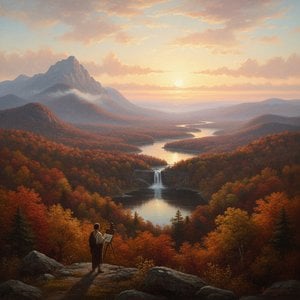
Liu Yu: Bridging Tradition and Innovation in Landscape Painting
Liu Yu (劉玉), born Xuancheng, China (1620), stands as a pivotal figure within the Anhui School of landscape painting—a movement that profoundly shaped Chinese art history during the Qing Dynasty. His artistic journey exemplifies a masterful synthesis of established stylistic conventions with contemporary sensibilities, resulting in works imbued with both serene beauty and intellectual depth. Unlike many artists of his era who adhered rigidly to formal doctrines, Liu Yu embraced experimentation while retaining an unwavering respect for the legacy of Dong Qichang (1555–1636) and Wang Hui (1632–1717), establishing him as a uniquely influential voice within the artistic landscape.
Early Life & Training
Born into a family steeped in Confucian traditions, Liu Yu’s formative years were marked by exposure to scholarly pursuits—a cornerstone of Anhui culture—which undoubtedly instilled in him a meticulous attention to detail and an appreciation for philosophical contemplation. Biographical information regarding Liu Yu remains scarce, yet records indicate he honed his artistic skills under the tutelage of prominent masters – individuals who imparted techniques that would become hallmarks of his distinctive style. This dedication to scholarly pursuits mirrored the broader ethos of the Anhui School, prioritizing intellectual engagement alongside aesthetic refinement.
The Dong Qichang Influence
Liu Yu’s artistic vision was decisively shaped by Dong Qichang's groundbreaking approach to landscape painting—specifically, its emphasis on “scholarly amateurism.” This philosophy championed a deliberate rejection of technical virtuosity in favor of conveying profound emotional resonance and intellectual insight. Recognizing the importance of conveying feeling rather than merely replicating visual appearances, Liu Yu skillfully adopted Dong Qichang’s dry brushwork and tonal modulation – techniques that prioritized atmospheric perspective and capturing the elusive essence of nature. He understood that true artistic excellence resided not solely in technical prowess but also in fostering contemplation and wonder at the natural world—a conviction deeply rooted in Confucian thought.
Exploring Spatial Distortion & Artistic Freedom
Moving beyond mere imitation, Liu Yu actively challenged conventional artistic boundaries by incorporating spatial distortions – a technique championed by Wang Hui – into his compositions. These deliberate manipulations of scale and viewpoint served to heighten dramatic impact and convey a sense of awe at the grandeur of mountainous landscapes. This bold stylistic choice underscored Liu Yu’s commitment to artistic innovation while simultaneously honoring the traditions of his predecessors—demonstrating that progress could be achieved through thoughtful engagement with established forms. He skillfully blended Dong Qichang's dry brushwork with Wang Hui's spatial distortions, creating a visual language that transcended mere representation.
Notable Works & Exhibitions
Liu Yu’s oeuvre comprises numerous landscape scrolls – most notably “Traveling Amid Streams and Mountains” (1680) – which exemplify his mastery of Anhui School painting techniques. These works are characterized by their luminous tonal palette, meticulous rendering of mountain forms, and evocative depiction of waterfalls and forests. His paintings garnered acclaim both domestically and internationally—appearing in solo exhibitions at Hong-gah Museum and Kuandu Museum of Fine Art – cementing his reputation as one of Nanjing’s most celebrated painters. The careful balance between atmospheric depth and compositional harmony reflected Liu Yu's profound understanding of artistic principles.
Legacy & Historical Significance
Liu Yu’s enduring legacy extends beyond his individual achievements—he served as a conduit for transmitting Dong Qichang's philosophical principles to subsequent generations of painters. His embrace of spatial distortion and stylistic experimentation foreshadowed developments in later Chinese art – demonstrating the enduring influence of Anhui School aesthetics. Furthermore, Liu Yu’s commitment to capturing the sublime beauty of nature resonated with broader cultural currents—affirming the importance of humanist ideals alongside aesthetic appreciation. He remains a symbol of artistic integrity and intellectual curiosity—a testament to the transformative power of art to enrich human experience.