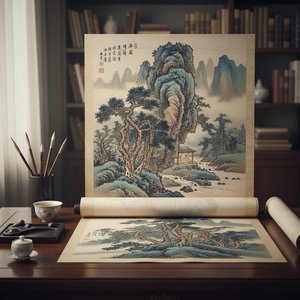
Li K'an (1245-1320): The Poet Painter of Bamboo
Li K’an, also known as li kan, stands as a beacon of artistic achievement during the Yuan Dynasty (1271–1368), a period marked by cultural dynamism and Mongol rule in China. Born around 1245 in Jiqu County, present-day Beijing—a region steeped in Taoist tradition—Li K’an's life was interwoven with both imperial service and profound engagement with the natural world, experiences that indelibly shaped his distinctive artistic vision. His sobriquet, xi zhai (“Bamboo Studio”), reflects not merely a place of residence but an embodiment of his creative ethos: a dedication to capturing the essence of simplicity and resilience through meticulously rendered ink paintings.
Early Life and Artistic Formation
Li K’an's formative years were spent in Jiqiu County, where he absorbed the aesthetic sensibilities fostered by the surrounding bamboo valleys—a landscape celebrated for its serenity and symbolic representation of perseverance. This environment profoundly influenced his artistic style, evident in the subtle brushstrokes and remarkable realism that characterize his most iconic works. He received formal training under Wen Tong, a revered Yuan Dynasty painter whose mastery of tonal ink wash technique established a cornerstone for Li K’an's own approach. Wen Tong’s influence is palpable in Li K’an’s meticulous attention to detail and his ability to convey atmospheric depth—qualities that elevate his paintings beyond mere depictions of bamboo to expressions of profound philosophical contemplation.
The Style of Wen Tong: Precision and Atmosphere
Li K’an's artistic style can be definitively categorized as rooted in the Wen Tong School, a movement distinguished by its unwavering commitment to capturing natural beauty with unparalleled accuracy. Unlike many contemporaries who favored stylized representations, Li K’an prioritized realism—a daring choice that demanded exceptional technical skill. He achieved this feat through painstaking observation and masterful control of ink wash technique, meticulously layering tones to simulate the subtle gradations of light and shadow found in bamboo groves. This dedication to capturing atmospheric conditions—the misty mornings, dappled sunlight filtering through foliage—transformed his paintings into immersive experiences for the viewer, mirroring the contemplative spirit of Taoist philosophy.
Notable Works: Bamboo and Rocks – A Testament to Skill
Among Li K’an's enduring masterpieces is “Bamboo and Rocks,” a painting housed at The Metropolitan Museum of Art (https://www.metmuseum.org/art/collection/search/40456). This artwork exemplifies Li K’an’s stylistic hallmarks: refined brushstrokes, meticulous rendering of textures—particularly the bamboo stalks—and an evocative depiction of rocky outcrops bathed in diffused light. The composition itself is carefully balanced, reflecting a harmonious relationship between man and nature—a central theme in Chinese art throughout history. It serves as a powerful reminder of Li K’an's ability to distill complex ideas into visually arresting images that resonate with timeless beauty.
Legacy and Influence
Li K’an’s artistic legacy extends far beyond the individual paintings themselves. He established himself as one of the foremost practitioners of Wen Tong style, influencing generations of subsequent artists who sought to emulate his mastery of tonal ink wash technique and his profound understanding of natural landscapes. His work continues to inspire admiration for its understated elegance and its capacity to convey spiritual depth—qualities that solidify Li K’an's place among China’s most celebrated painters of the Yuan Dynasty. Further exploration into Li K’an’s oeuvre can be found on WahooArt.com (https://WahooArt.com/art.nsf/art_en?open&query=li+kan&), where you can discover additional treasures of Chinese art history.