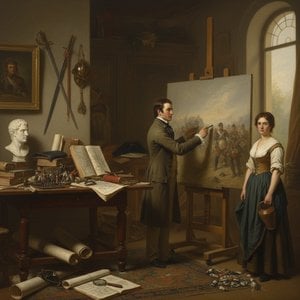
Christian Leopold Bode (1831 – 1906): A Painter of Romantic Detail
Christian Leopold Bode (born March 11, 1831, in Offenbach am Main; died July 26, 1906, in Frankfurt am Main) was a German historical painter and graphic artist who achieved renown for his meticulous renderings of 19th-century life and interiors—particularly those imbued with the spirit of Romanticism. He belonged to a prominent artistic lineage, being the eldest son of landscape painter Georg Wilhelm Bode and Anna Maria. From 1848, Bode pursued formal training at the Städel in Frankfurt under the tutelage of Jakob Becker and Johann David Passavant, establishing a foundation for his future artistic endeavors.
A pivotal moment arrived in 1851 when Bode accepted the mentorship of Eduard von Steinle, furthering his artistic education and broadening his stylistic horizons. Shortly thereafter, he married Catharina Elisabeth Geiger (1826–1856), marking the beginning of a familial partnership that would shape his life’s trajectory. Following graduation in 1859, Bode married Catharina's sister Mary Margaret, with whom he established a household and raised three children. His studio resided at the Städel and, notably, within the opulent Schloss Eisenburg in Offenbach—a location that served as an enduring inspiration for countless exterior and interior views captured in his paintings.
Bode’s artistic journey began amidst the burgeoning Romantic movement, a period characterized by fervent emotion and imaginative exploration of the sublime. Influenced profoundly by artists like Caspar David Friedrich and Eugène Delacroix, Bode embraced the stylistic conventions of Nazarene painting—a reaction against Neoclassical formalism—prioritizing spiritual contemplation alongside meticulous observation of nature. This dedication to realism combined with Romantic sensibilities resulted in canvases that captured not only the visual appearance of subjects but also their emotional essence.
His early works showcased a remarkable sensitivity to light and color, mirroring the Impressionist preoccupation with capturing fleeting moments of beauty. However, Bode swiftly transitioned towards historical painting—particularly portraits—demonstrating an exceptional ability to convey character and psychological depth. Collaborations with Eduard von Steinle at the Wallraf-Richartz Museum in Cologne solidified his artistic reputation, fostering a dialogue between tradition and innovation.
Among Bode’s most celebrated achievements were his depictions of Schloss Eisenburg, Offenbach—a project that consumed years of painstaking effort and resulted in breathtaking panoramas reflecting aristocratic grandeur. These canvases exemplify Bode's mastery of architectural perspective and his unwavering commitment to capturing the atmosphere of specific spaces. Furthermore, Bode’s meticulous attention to detail—evident in portraits like “Wolfgang Amadeus Mozart as a Boy”—established him as one of the foremost practitioners of Romantic realism.
Bode’s legacy extends beyond individual artworks; he served as Professor at Goethe University Frankfurt and was honored by Grand Duke Ernest Louis for his contribution to German art scholarship. His paintings are now housed in prestigious museums across Germany, including the Bode Museum in Berlin and the Leopold Museum in Vienna—a testament to his enduring influence on artistic expression. Bode’s oeuvre continues to inspire artists and scholars alike, securing his place as a pivotal figure within the history of Romantic painting.
- Notable Subjects: Bode frequently depicted portraits of prominent figures from his time, alongside genre paintings that explored themes of domestic life and social interaction.
- Influences: Bode’s artistic vision was profoundly shaped by the Romantic movement, drawing inspiration from artists like Caspar David Friedrich and Eugène Delacroix. He also absorbed stylistic elements from Realist painters such as Wilhelm Leibl and Anton Melbye, demonstrating a sophisticated understanding of artistic trends.
- Major Achievements: Bode’s collaborative work on the chancel niches in Aachen Cathedral and the chapel of Löwestein Castle showcased his technical prowess and artistic ambition.
- Collaborations: Bode worked closely with Eduard von Steinle at the Wallraf-Richartz Museum, fostering a dynamic exchange between artistic sensibilities.
Christian Leopold Bode’s paintings remain treasured masterpieces of Romantic realism—a poignant reminder of an artist who dedicated his life to capturing the beauty and complexity of the human experience.