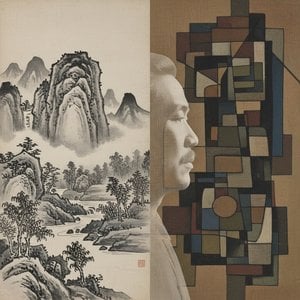
Kim Byung-jong (Dan-A): A Synthesis of East and West
Kim Byung-jong, known professionally as Dan-A, stands as a prominent figure in contemporary Korean painting, recognized for his distinctive artistic approach that seamlessly blends Eastern traditions with Western influences. Born in Seoul, South Korea, in 1953, Kim’s journey into art began amidst the burgeoning cultural landscape of post-war Korea and has evolved into a career marked by unwavering dedication to exploring themes of life, nature, and spirituality.
Early Influences & Education
Kim’s formative years were deeply impacted by Seoul National University's College of Fine Arts, where he honed his skills in oriental painting—a discipline rooted in centuries of Korean artistic heritage. This foundational training instilled within him a profound appreciation for brushwork techniques and compositional principles characteristic of traditional ink wash landscapes and portraits. The meticulous observation of natural forms—particularly the subtle gradations of color found in Korean mountains and forests—became an enduring preoccupation, shaping his artistic vision throughout his career. He studied under renowned masters who championed the expressive potential of calligraphy and landscape painting, absorbing their wisdom and integrating it into his own distinctive style.
The Turning Point
A serious accident in 1989 served as a catalyst for Kim’s artistic introspection, prompting him to confront mortality and fostering an enduring fascination with the fragility and beauty of existence. This pivotal experience fueled his desire to capture the essence of life—a theme that would become central to his oeuvre. Seeking solace amidst hardship, he turned to painting as a means of conveying profound emotions and grappling with existential questions—a practice that profoundly influenced his artistic sensibility and solidified his commitment to exploring themes of vulnerability and resilience. The accident instilled in him a deep appreciation for the transient nature of beauty and prompted him to contemplate the interconnectedness between humanity and the natural world.
Style & Technique
Dan-A's signature style distinguishes itself through a masterful fusion of Eastern and Western aesthetics. He employs textured canvases, often incorporating Hanji (Korean mulberry paper), to imbue his paintings with tactile qualities reminiscent of traditional Korean art forms—a deliberate choice that reflects Korea’s rich artisanal heritage and underscores his respect for craftsmanship. Simultaneously, he draws inspiration from Impressionistic color palettes and compositional strategies, resulting in works that resonate with both visual richness and emotional depth. His brushwork is characterized by fluidity and spontaneity, mirroring the dynamic energy of nature while maintaining a contemplative stillness—a stylistic hallmark that distinguishes him from many Western artists of his time. He meticulously blends pigments to achieve luminous hues and subtle tonal variations, capturing the ethereal beauty of landscapes bathed in sunlight or the solemn dignity of portraits rendered with meticulous detail.
Exploring Life’s Essence Through Landscape & Portraiture
Kim Byung-jong's artistic vision consistently centers on portraying the profound interconnectedness between humanity and nature—a motif powerfully expressed in his landscape paintings. Recurring motifs include cranes, birds, and fish, symbolizing longevity, harmony, and spiritual aspiration. These elements are meticulously arranged against serene backgrounds rendered with subtle gradations of color, mirroring the contemplative spirit of Zen Buddhism and reflecting Korea’s rich cultural heritage. He seeks to convey not only visual splendor but also a deeper understanding of the natural world's rhythms and cycles—a perspective informed by centuries of Korean philosophical tradition. His landscapes are imbued with symbolic resonance, inviting viewers to contemplate themes of impermanence and renewal.
Recognition & Legacy
Throughout his prolific career, Kim Byung-jong has garnered considerable acclaim for his artistic contributions—receiving the Korea Order of Cultural Merit in 2014 from the Ministry of Culture, Sports and Tourism—a testament to his enduring influence on Korean art. His work has been exhibited internationally, showcasing his distinctive style and furthering dialogue between Eastern and Western artistic traditions. He served as Director of Seoul National University Museum from 2002 to 2004, actively promoting the preservation and dissemination of Korean art history. Furthermore, he generously donated approximately 440 artworks—including his celebrated “Song of Life” series—to the Kim Byungjong Art Museum established in Namwon, bolstering the city’s cultural landscape and ensuring that his artistic legacy would endure for generations to come. His unwavering commitment to capturing the essence of life through art underscores his enduring belief in the transformative power of creative expression and reaffirms his position as a pivotal voice within Korean contemporary art.