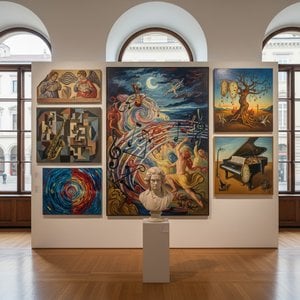
Kerolayne Kemblin: Bridging Tradition and Innovation in Amazonian Art
Kerolayne Kemblin, born in Manaus, Brazil, stands as a compelling figure within the landscape of contemporary Brazilian art—specifically, one deeply rooted in the profound cultural heritage of the Amazon rainforest. Her artistic trajectory represents a masterful fusion between indigenous traditions and experimental artistic methodologies: collage, graffiti, lambe-lambes, and digital image manipulation—a deliberate choice that underscores her unwavering connection to the region’s identity and its urgent imperative for preservation.
Education & Artistic Foundations
Kemblin's intellectual journey commenced with a degree in Visual Arts from Universidade Federal Amazônica (UFAM), equipping her with both foundational artistic principles and an acute awareness of Amazonian ecological concerns. This academic grounding served as the bedrock upon which she built her distinctive creative vision—a perspective informed by a deep understanding of art history alongside a fervent dedication to safeguarding the rainforest’s biodiversity.
Technique & Style: Layers of Texture and Narrative
Kemblin's artistic style is characterized by an ambitious layering process—she meticulously combines imagery and textures onto digital canvases, often incorporating fragments of plant specimens into her compositions. This technique isn’t merely stylistic; it embodies a profound engagement with umbanda spirituality and AfroDiasporic traditions—elements that permeate her thematic explorations. Her artwork delves into concepts such as memory, resilience, and interconnectedness—themes that resonate powerfully within the context of Amazonian culture and its ongoing struggle for recognition.
Exhibitions & Recognition: Expanding Artistic Horizons
Kemblin’s artistic endeavors have garnered considerable acclaim through participation in pivotal cultural events. Notably, her inclusion in ‘Enciclopédia Negra,’ a project dedicated to showcasing Black artists and their contributions to Brazilian culture, exemplifies her commitment to amplifying voices often excluded from mainstream narratives. Furthermore, her involvement in ‘Arte Fora do Museu’ underscores her belief that art should transcend institutional boundaries—reaching audiences beyond the confines of conventional galleries and fostering dialogue about artistic expression as a catalyst for social change.
Exploring Amazonian Identity Through Collage & Graffiti
Kemblin's creative process transcends mere visual aesthetics; it constitutes a deliberate act of storytelling. She harnesses collage techniques—assembling disparate elements like photographs, botanical specimens, and handwritten text—to construct narratives that confront the challenges posed by environmental degradation and cultural preservation. Simultaneously, she employs graffiti art as a medium for social commentary—injecting vibrant color and rebellious energy into urban spaces to amplify voices frequently silenced by societal norms. Her work serves as a powerful reminder of the importance of artistic intervention in addressing pressing social issues.
Legacy & Artistic Significance
Kerolayne Kemblin’s contribution to Brazilian art is marked by her pioneering blend of traditional Amazonian symbolism with avant-garde techniques—a fusion that distinguishes her oeuvre from many contemporary artists. Her unwavering dedication to preserving cultural heritage while embracing innovation as a tool for shaping a more equitable future cements her place within the broader artistic canon—a testament to the transformative potential inherent in creative expression and its capacity to inspire meaningful dialogue about societal values.