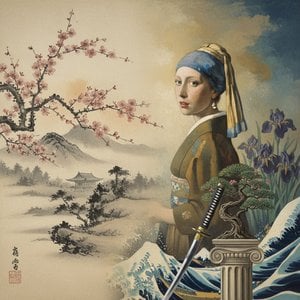
Katori Nahiko: Echoes of Kyoto and the Soulful Depiction of Fish
Katori Nahiko (楫取魚彦, Nabiko), born April 6th, 1723, in Sawara, Japan, stands as a singular figure within the mid-Edo period’s artistic landscape—a philosopher, poet, and painter whose oeuvre embodies both intellectual rigor and profound aesthetic sensitivity. His life unfolded against the backdrop of a rapidly changing nation grappling with Western influence, yet he steadfastly clung to traditions rooted in Kyoto’s refined cultural heritage.Early Life & Influences: Born into a family involved in textiles, Katori’s upbringing instilled in him an appreciation for craftsmanship and meticulous observation. The untimely death of his father at six profoundly shaped his formative years, fostering resilience and prompting him to seek solace in scholarly pursuits under the tutelage of Takebe Ayatari, a pivotal figure in Kyoto’s artistic education.
Takebe Ayatari’s guidance proved instrumental in Katori’s artistic development. Recognizing the importance of preserving cultural heritage, Ayatari instilled within him the core tenets of kokugaku—the study of classical Japanese texts—a discipline that would profoundly inform his worldview and artistic sensibilities. This intellectual foundation underpinned Katori's lifelong fascination with waka poetry, shaping his poetic voice and influencing his visual representations.
The Pursuit of Kokugaku & Poetic Expression: Katori’s engagement with kokugaku fostered a deep understanding of Japanese history and philosophy, enriching his artistic perspective. He meticulously studied the works of Confucius and Lao Tzu, absorbing their wisdom and applying its principles to his creative endeavors. This scholarly immersion is vividly reflected in his lyrical compositions—characterized by a masterful command of rhythm and imagery—where echoes of classical thought intertwine with evocative natural landscapes.
Painting Technique & Symbolism: Katori Nahiko’s artistic style distinguished itself through its captivating portrayal of fish—a motif that recurs throughout his paintings with remarkable consistency. He skillfully employed brushstrokes imbued with subtle nuances to convey emotion and capture the essence of nature, reflecting Kyoto's aesthetic ideals. His technique prioritized capturing fleeting moments of beauty—the delicate ripples of water, the vibrant colors of autumn foliage—demonstrating a profound connection to the natural world.
Family Legacy & Artistic Transition: Recognizing the importance of continuity, Katori entrusted his family business to his son, allowing him to pursue his artistic ambitions independently. Moving to Edo in 1765, he established a studio near Kamo no Mabuchi’s residence, furthering his connection with Kyoto's intellectual elite. This relocation signaled a pivotal moment in his life—a deliberate choice to prioritize creative pursuits while maintaining ties to the cultural center of Japan.
Recognition & Scholarly Contributions: Katori Nahiko achieved considerable renown as one of the “twelve great scholars” associated with Kamo no Mabuchi’s school. His scholarly works—including ‘ Kogentei’ (leiter zu alten worten) and ‘Man’yōshū Senka’ (1000 songs from the Man’yōshū)—demonstrate his dedication to preserving and disseminating classical knowledge, cementing his place as a cornerstone of Edo period intellectual culture. He was particularly honored by Prince Nakatsu of Buzen Province for his erudition and artistic accomplishments.
Katori Nahiko passed away on May 5th, 1782, leaving behind a legacy of artistic excellence and scholarly devotion. His paintings continue to resonate with viewers today, offering glimpses into the contemplative spirit of Kyoto and embodying the enduring beauty found within the natural world—a testament to his profound understanding of both art and philosophy.