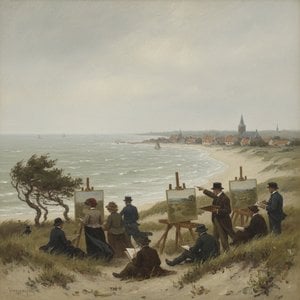
Still Life with a Group of Eight Mackerel in a Broken Basket A Study on Yarmouth Beach, Norfolk
The River at Thorpe, Norfolk
Landscape
Art period: Siglo XIX
Museums on APS:
National Trust
Fitzwilliam College
Lifespan: 33 years
Joseph Stannard: A Norfolk Master of Light and Landscape
Joseph Stannard (1797–1830) stands as a remarkable figure within the Norwich School of Painters, an artistic movement that flourished in Norfolk during the early Victorian era. Born in Norwich on September 13th, 1797, his formative years were shaped by the tutelage of John Crome—a celebrated landscape artist himself—who recognized Stannard’s prodigious talent and secured him a place at Norwich Grammar School. Despite facing financial constraints that necessitated a shift to Robert Ladbrooke as instructor, Stannard's artistic journey quickly gained momentum, establishing him as a prominent voice within the burgeoning Norfolk art scene.
Early Career & Societal Recognition
From his debut exhibition in 1811 at Norwich Society of Artists—a young boy showcasing remarkable skill—Stannard’s work garnered positive reviews in publications like The Norwich Mercury, cementing his reputation as a gifted artist. Critics lauded his ability to capture the subtle nuances of Norfolk’s coastal scenery and river landscapes with an unprecedented level of realism. This initial success fueled his ambition and solidified his commitment to artistic exploration.
Dissociation and Rivalry
Demonstrating unwavering conviction and artistic independence, Stannard severed ties with the Norwich Society of Artists in 1816, opting instead to establish a rival organization that briefly achieved considerable acclaim. This decisive action underscored his desire to pursue creative endeavors free from institutional constraints—a characteristic that would define much of his subsequent career.
Influences and Artistic Style
Stannard’s artistic vision was profoundly shaped by the legacy of Dutch masters, particularly Rembrandt and Vermeer. During a transformative trip to Holland in 1821, he immersed himself in their techniques, meticulously studying their masterful use of chiaroscuro—the dramatic interplay between light and shadow—and atmospheric perspective—creating illusions of depth and realism. These encounters instilled within him an appreciation for meticulous observation and the expressive power of tonal variation—principles that would become central to his distinctive style. His magnum opus, “Thorpe Water Frolic,” completed in 1825, exemplifies this mastery, capturing the serene beauty of Thorpe Waters with breathtaking realism and conveying a palpable sense of tranquility. The painting’s balanced composition—harmoniously arranged—further solidified Stannard's position as one of Norfolk’s foremost landscape artists.
Etchings & Artistic Legacy
In 1827, Stannard’s etchings were published in “Norfolk Etchings,” showcasing his technical prowess and expanding his artistic reach beyond painting. These prints demonstrated his ability to translate the luminous qualities of light onto a different medium—a testament to his versatility and dedication to honing his craft. His work continues to inspire admiration for its evocative depictions of Norfolk’s landscapes and its masterful execution of Dutch artistic principles.
Personal Life & Family Connections
Married to Emily Coppin in 1826—a fellow artist who achieved considerable acclaim herself—Stannard established a family rooted in artistic pursuits. His daughter, Emily Stannard, and several other relatives continued the tradition of artistic creation, ensuring that Stannard’s influence endured across generations. Tragically, Stannard succumbed to tuberculosis in 1830 at the young age of thirty-three—a poignant reminder of the fragility of life and the enduring power of artistic inspiration.
Por el equipo editorial de WahooArt.com
Cuestionario de arte
Cada pregunta tiene una única respuesta correcta.
Pregunta 1:
¿Qué movimiento artístico influyó profundamente en el estilo de Joseph Stannard después de un viaje a Holanda?
Pregunta 2:
¿Quién fue el pintor norwichiano que guiñó a Joseph Stannard al inicio de su carrera artística?
Pregunta 3:
¿Cuál era el título de la obra maestra de Stannard, capturando la belleza de Norfolk?
Pregunta 4:
¿En qué año Joseph Stannard se casó con Emily Coppin, una artista conocida por sus obras maestras?
Pregunta 5:
¿Qué tipo de arte destacó Emily Stannard después de la muerte de su esposo?
Explore the ethereal beauty of the Hague School art movement. Discover how masters like Jan Weissenbruch captured the atmospheric grey light of the Dutch landscape through unparalleled technique and emotive, misty compositions.
¡Hola! Puedo ayudarte a elegir una obra de arte, realizar el seguimiento de un pedido o resolver tus dudas sobre la garantía. ¿En qué puedo ayudarte hoy?