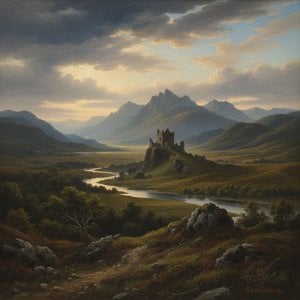
Jonas Mackevičius: A Baltic Romantic Landscape Painter
Jonas Mackevičius (1872 – 1954) stands as a pivotal figure in Lithuanian art history, recognized primarily for his masterful depictions of the Baltic landscape and portraits imbued with romantic sensibilities. Born in Rūga, Panevežys County, Lithuania, Mackevičius embarked on an artistic journey marked by rigorous academic training and extensive travels across Europe—a formative experience that profoundly shaped his distinctive style and worldview.
Early Life & Education:
Mackevičius’s formal education began at the Moscow Art Promotion School, where he honed his skills in drawing and composition under the tutelage of Princess Taniševa’s renowned art studio. This early training instilled in him a foundational understanding of artistic principles that would underpin his subsequent endeavors. Subsequently, he enrolled at St. Petersburg Academy of Arts, delving deeper into painting techniques and mastering classical aesthetics. His professors included Vasily Makovskis and Pavel Kovalevskis, figures who championed realism and artistic excellence—influences that decisively shaped Mackevičius’s artistic vision.
European Travels & Artistic Influences:
Mackevičius’s artistic development was inextricably linked to his travels throughout Europe. He immersed himself in the vibrant cultural milieu of Italy, Germany, France, Spain, and Turkey—absorbing inspiration from Impressionism and plein air painting traditions. These experiences fueled his passion for capturing fleeting moments of beauty and conveying emotional depth within his canvases. Notably, he participated in the inaugural Lithuanian Art Exhibition in Vilnius (1907) and joined the Lithuanian Artists’ Association, cementing his role as a champion of Lithuanian artistic identity. The Impressionist movement's emphasis on light and color—particularly evident in landscapes like “Capri Salos prieplauka”—became a cornerstone of Mackevičius’s stylistic approach.
Lithuanian Artistic Landscape:
Mackevičius's landscapes are characterized by meticulous detail and luminous color palettes—particularly evident in works like “Capri Salos prieplauka” (circa 1921) and “Aguonų laukas,” which exemplify the Romantic movement’s fascination with dramatic skies and evocativ vistas. He meticulously rendered textures, capturing the nuances of weather conditions and geological formations with remarkable accuracy. These paintings are not merely representations of scenery; they strive to evoke a profound emotional response in the viewer—a testament to Mackevičius's artistic sensitivity and his ability to translate visual experience into expressive art. The grandeur of Baltic nature—the turbulent seas, towering mountains, and expansive plains—became recurring themes in his oeuvre.
Portraiture & Psychological Depth:
Beyond landscapes, Mackevičius excelled in portrait painting, capturing not merely physical likeness but also psychological nuance. His portraits of Tsar Nicholas II (1904) and prominent Lithuanian figures demonstrate his ability to convey inner emotions and character traits. He skillfully employed chiaroscuro—the dramatic interplay of light and shadow—to sculpt the faces of his subjects, creating images that resonate with depth and complexity. Mackevičius’s portraits are imbued with a humanist spirit—reflecting his belief in the importance of portraying individuals authentically and compassionately.
Notable Achievements & Legacy:
Mackevičius’s artistic legacy extends beyond individual masterpieces; he played a crucial role in establishing Lithuania's artistic presence on the international stage. His involvement with the Vytautas the Great War Museum—particularly his monumental paintings “Lithuanian Army March in Vilnius” and “The Priest A. Mackevičius Blesses Rebels’ of the Year 1863 Flags”—served as powerful visual narratives of Lithuanian history and national identity. These canvases powerfully conveyed the spirit of a nation striving for independence, utilizing bold colors and dynamic compositions to capture the fervor of patriotic sentiment. Furthermore, he contributed significantly to the artistic discourse of his time, advocating for realism and romanticism as expressive mediums—a stance that cemented his position as a leading voice in Lithuanian art. Mackevičius received considerable acclaim during his lifetime, culminating in the Order of Gediminas III degree (1938)—a testament to his dedication and contribution to Lithuanian culture. His enduring influence can be seen in the continuing appreciation for Lithuanian Romantic landscape painting—a stylistic tradition that continues to inspire artists today.
Collections & Exhibitions:
Mackevičius’s paintings are housed in prestigious museums across Lithuania and internationally, including the National Museum of Art in Vilnius—a testament to their enduring artistic merit. His oeuvre continues to inspire artists and scholars alike, ensuring that Jonas Mackevičius's contribution to Lithuanian art history remains firmly established for generations to come.