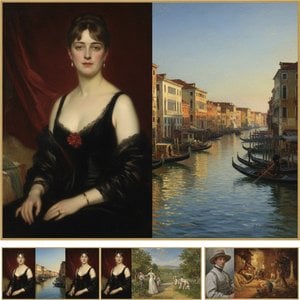
John McLure Hamilton: A Portraitist Bridging Cultures
John McLure Hamilton (1853-1936) stands as a singular figure in the annals of American art history—a painter who seamlessly traversed continents and embraced diverse artistic traditions, ultimately establishing himself as one of Britain’s most celebrated portraitists. Born in Philadelphia to Scottish parents, Hamilton possessed an innate curiosity that propelled him beyond the confines of his birthplace, embarking on a lifelong journey of intellectual and artistic exploration. His formative years were spent honing his skills at the Pennsylvania Academy of Fine Arts under the tutelage of Thomas Eakins, arguably one of America’s foremost realist painters—a connection that profoundly shaped Hamilton's aesthetic sensibilities and instilled in him an unwavering commitment to meticulous observation and anatomical accuracy.
Early Influences: Hamilton’s artistic vision was nurtured by a rich tapestry of influences. Beyond Eakins, he absorbed inspiration from Impressionism, particularly the vibrant palettes and fleeting effects of light championed by Claude Monet and Pierre-Auguste Renoir. These encounters instilled in him a desire to capture not merely likeness but also the essence of his subjects—their moods, emotions, and inner lives.
European Sojourn: Recognizing the imperative for further artistic development, Hamilton traveled extensively throughout Europe during the late Victorian era. He spent considerable time studying at the École des Beaux-Arts in Paris and the Royal Academy in Brussels, immersing himself in the stylistic innovations of European painting. This immersion solidified his mastery of technique and broadened his understanding of artistic discourse.
A Career Defined by Dignified Portraits
Hamilton’s professional career unfolded with remarkable distinction, primarily focused on portraiture—a genre he approached with unwavering dedication and unparalleled skill. He quickly gained renown for his ability to convey character and personality through meticulously rendered likenesses, earning commissions from prominent figures across Britain. His portraits of William Ewart Gladstone, Prime Minister of the United Kingdom for over two decades, stand as enduring monuments to his artistic prowess—capturing Gladstone’s solemn countenance and conveying a palpable sense of gravitas. Hamilton's meticulous attention to detail extended beyond mere visual representation; he sought to imbue each portrait with psychological insight, reflecting the sitter’s inner world alongside their outward appearance.
Notable Subjects: Among his illustrious clientele were Cardinal Manning, George Meredith, Richard Vaughan and many others. Hamilton's portraits of these figures are celebrated for their nuanced portrayal of intellect and spirituality—demonstrating his ability to capture the complexities of human experience.
Technique & Style: Hamilton’s artistic style was characterized by a blend of realism and Impressionistic influences. He employed oil paints with remarkable precision, layering glazes to achieve luminous surfaces and subtle tonal variations that conveyed depth and atmosphere. His canvases possessed an understated elegance—reflecting his belief in the primacy of observation and the importance of capturing the fleeting beauty of the human form.
Men I Have Painted: A Literary Reflection on Artistic Practice
Hamilton’s artistic legacy extended beyond his paintings into the realm of literature. He penned “Men I Have Painted,” a memoir that offered invaluable insights into his artistic process and illuminated the personalities of those he depicted—a testament to his intellectual curiosity and his desire to engage in dialogue with his subjects. The book recounts anecdotes about Gladstone, Bismarck, Asquith, Balfour, Manning and Vaughan, revealing Hamilton’s meticulous approach to portraiture as well as his keen understanding of human psychology.
Historical Significance & Legacy
Hamilton's contribution to British art history is undeniable. He helped establish a tradition of dignified portraiture that continues to inspire artists today. His work exemplifies the Victorian ideal of intellectual rigor combined with artistic sensitivity—a synthesis that reflects the broader cultural currents of his era. Hamilton’s enduring reputation rests not merely on his technical skill but also on his profound empathy for his subjects—demonstrating his conviction that art should serve as a conduit for understanding and appreciating the human condition. His meticulous portraits remain treasured artifacts, offering glimpses into the lives and minds of some of Britain's most influential figures.
Explore the life & art of John Gilbert, a prolific Victorian painter renowned for his captivating genre scenes and Venetian-inspired style. Discover his legacy with WahooArt.
Descubre las 25 obras maestras de John Singer Sargent, el maestro del retrato y la Belle Époque. Explora su técnica impresionista, historias fascinantes y encuentra reproducciones de arte exclusivas para decorar tu hogar con elegancia en WahooArt.com.
Discover the captivating world of John Graham Gilbert, a Victorian master! Explore his portraits, genre scenes & illustrations. Learn about his influences, legacy & find high-quality reproductions at WahooArt.
¡Hola! Puedo ayudarte a elegir una obra de arte, realizar el seguimiento de un pedido o resolver tus dudas sobre la garantía. ¿En qué puedo ayudarte hoy?