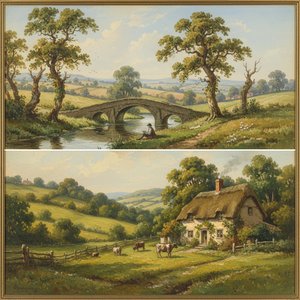
John Herbert Caddy: A Canadian Explorer and Watercolorist Bridging Victorian Science and Artistic Vision
John Herbert Caddy (June 28, 1801 – March 19, 1883) was a multifaceted Canadian figure—artist, soldier, engineer, educator, diarist, and explorer—whose prolific watercolor paintings capture the spirit of his era while reflecting a deep fascination with both natural landscapes and archaeological discoveries. Born in Quebec City, Lower Canada, Caddy’s early life foreshadowed his adventurous trajectory as he pursued formal training at the Royal Military Academy Woolwich in England, immersing himself in the burgeoning field of topographical sketching and painting alongside fellow officers like George Heriot. This formative experience instilled a meticulous attention to detail and an appreciation for scientific observation that would permeate his artistic endeavors throughout his lifetime.
Early Life & Education: The Seeds of Observation
At fourteen years old, Caddy embarked on a transformative journey to England, dedicating himself to mastering engineering principles at Woolwich before honing his artistic skills through topographical studies. His exposure to Heriot’s pioneering approach to landscape painting undoubtedly influenced his stylistic choices—a deliberate embrace of scientific observation combined with an aesthetic sensibility attuned to capturing the sublime beauty of nature. Heriot's insistence on accurate measurement and detailed rendering served as a crucial catalyst for Caddy’s artistic development, shaping his technique and informing his compositional decisions.
Military Service & Travels Abroad: Mapping Adventure
Caddy swiftly ascended the ranks of the British Army, serving as a lieutenant and later captain, undertaking expeditions to Tobago (1828), St Lucia (1833), St Vincent (1834), Belize (1838), London (1842) and Hamilton (1851). These voyages provided invaluable material for his artistic inspiration, documenting diverse environments from tropical islands to the Canadian frontier. Each journey demanded meticulous record-keeping—not merely of logistical necessities but also of visual impressions—resulting in sketches and watercolors that documented geological formations, flora, fauna, and architectural landmarks with remarkable precision. The landscapes encountered during these expeditions became recurring motifs in Caddy’s oeuvre, reflecting his unwavering commitment to capturing the grandeur of the natural world.
The Mayan Expedition & Scientific Documentation: Combining Artistry and Archaeology
Perhaps Caddy’s most celebrated achievement was his leadership of an expedition to Palenque in 1839—a pivotal moment in Mayan archaeology and a testament to his commitment to combining artistic creativity with scientific rigor. He meticulously recorded his observations, sketching landscapes and architectural details alongside detailed textual descriptions intended for publication as a comprehensive report. This ambitious undertaking underscored Caddy’s belief that art could serve as a powerful tool for disseminating knowledge and fostering understanding of ancient civilizations—a conviction that resonated deeply within the intellectual climate of Victorian Britain. The expedition's findings significantly advanced Mayan scholarship, cementing Caddy’s reputation as both an artist and a visionary explorer.
Return to Woolwich & Artistic Development: Refining Technique
Returning to Woolwich in 1841, Caddy continued his engineering career but simultaneously rekindled his passion for painting, focusing on capturing the beauty of Ontario’s lakes and forests. He established a studio and served as an art instructor, fostering the artistic talents of younger generations while maintaining his own prolific output. During this period, Caddy honed his watercolor technique—employing subtle tonal harmonies and masterful atmospheric perspective to convey mood and atmosphere—drawing inspiration from the Romantic landscape painters Turner and Constable. His meticulous attention to detail mirrored the precision demanded by his engineering profession, demonstrating a remarkable ability to synthesize disparate disciplines into a cohesive artistic vision.
Legacy & Recognition: A Canadian Landscape Pioneer
From 1858 to 1868, Caddy exhibited watercolors and oils in the annual Provincial Exhibitions of Ontario, securing recognition for his contribution to Canadian landscape painting. His family’s involvement in art further cemented his place as a prominent figure within Canada's artistic community—a testament to his enduring influence on subsequent generations of artists who sought to emulate his masterful technique and capture the spirit of the Canadian wilderness. John Herbert Caddy remains remembered not only for his stunning watercolor landscapes but also for embodying a Canadian ethos characterized by curiosity, exploration, and an unwavering appreciation for the sublime beauty of nature.