John Hamilton Mortimer (1740–1779): A Pioneer of Romantic Landscape Painting
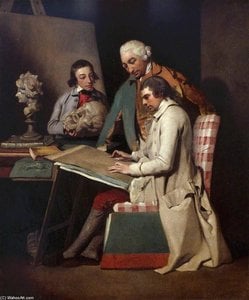
John Hamilton Mortimer (1740–1779) stands as a singular figure in British art history, recognized primarily for his evocative landscapes imbued with the spirit of Romanticism and his masterful depictions of conversation scenes. Though overshadowed by contemporaries like Turner and Constable, Mortimer’s contribution to the artistic landscape of his era deserves careful consideration. His work reflects an intellectual curiosity combined with a profound sensitivity to the natural world—a duality that distinguishes him from many of his peers.- Early Life and Education: Born in Eastbourne, Sussex, Mortimer's upbringing instilled in him a love for observation and meticulous detail. He attended Duke of Richmond’s Academy, where he honed his artistic skills alongside Joseph Wright, forging a lifelong friendship that profoundly influenced his creative vision. This formative period exposed him to the burgeoning ideals of Enlightenment thought, shaping his approach to art as both an intellectual pursuit and a conduit for emotional expression.
- Career Highlights: Mortimer quickly established himself as a respected artist, exhibiting his works regularly in London’s artistic circles from the early 1760s onwards. He gained considerable acclaim for his paintings of historical subjects—particularly those exploring medieval British history—demonstrating an ambition to elevate art beyond mere decorative concerns. His association with Samuel Ireland fostered collaborative endeavors and contributed to the dissemination of innovative techniques, notably etching.
- Notable Paintings: Mortimer’s oeuvre includes iconic pieces such as “St Paul Preaching to the Ancient Druids in Britain,” a monumental canvas that captures the grandeur of British mythology and exemplifies his stylistic prowess. Equally impressive are his portraits commissioned by prominent figures like John D. Rockefeller and Maria Bicknell, showcasing his ability to convey psychological depth and capturing the essence of his subjects’ personalities.
- Influence and Legacy: Mortimer's artistic style—characterized by atmospheric perspective, dramatic lighting, and a preoccupation with conveying emotion—anticipated many developments in Romantic landscape painting. He drew inspiration from Salvator Rosa’s bold approach to genre painting, embracing a rebellious spirit that challenged academic conventions. His legacy resides not only in his individual artworks but also in his role as President of the Society of Artists, fostering artistic innovation and establishing himself as a pivotal figure in British art culture.
- Death and Recognition: Mortimer tragically succumbed to illness at the young age of 39, leaving behind an unfinished body of work that continues to fascinate scholars and collectors alike. Despite his brief career, he achieved considerable renown during his lifetime and remains celebrated today as one of Britain’s most original landscape painters—a testament to his unwavering dedication to artistic excellence and his enduring contribution to the Romantic movement.
Technical Considerations: Mortimer's Approach to Landscape Painting
Mortimer’s landscapes weren’t merely representations of scenery; they were carefully constructed narratives designed to evoke emotion and convey profound ideas. He meticulously studied topographical maps and geological formations, striving for accuracy while simultaneously prioritizing artistic impression. His technique involved layering thin washes of color—often achieved through glazing—to build up atmospheric depth and luminosity. This method allowed him to capture the subtle nuances of light and shadow, creating canvases that pulsate with life and conveying a sense of sublime grandeur. Furthermore, Mortimer’s use of etching—particularly in collaboration with Samuel Ireland—provided an alternative medium for exploring similar themes of observation and emotional resonance.Preguntas y respuestas
¿Puedo explorar las obras de John Hamilton Mortimer por técnica?
Para encontrar todas las obras de John Hamilton Mortimer por técnica, visite la página de Todas las técnicas del artista.
¿En qué ciudad y país nació John Hamilton Mortimer?
John Hamilton Mortimer nació en Eastbourne, Reino Unido.
¿Dónde se pueden explorar las obras de John Hamilton Mortimer clasificadas por tema?
Las obras de John Hamilton Mortimer pueden explorarse por tema en la página Índice temático del artista.