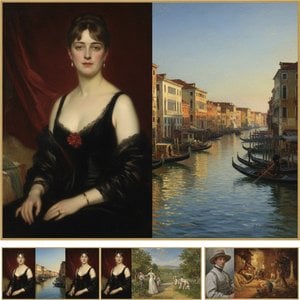
John Godwin Williams (c.1793–1863): Bridging East and West in Victorian Portraiture
John Godwin Williams, born around 1793 in Madras (now Chennai), India, was a British artist who achieved considerable renown during the Victorian era for his meticulously crafted portraits of prominent figures from both Britain and its colonial dominions. His artistic journey began at St John’s College, Cambridge, where he studied Classics alongside Fine Arts, fostering an intellectual curiosity that profoundly shaped his artistic vision. This dual engagement with scholarship and art would become a hallmark of his career, informing not only his subject matter but also the stylistic nuances of his paintings.
Williams' early training focused on watercolour painting, honing skills in capturing subtle tonal variations and atmospheric effects—techniques he would later adapt to oil paint. However, it was his relocation to Bombay (Mumbai) in 1823 that cemented his reputation as a portrait artist specializing in depictions of dignitaries and wealthy merchants. He quickly established himself as a sought-after painter, attracting commissions from influential families and individuals eager to commemorate their status and lineage. His portraits weren’t merely representations of likeness; they were carefully constructed narratives designed to convey prestige, character, and social standing.
A significant influence on Williams' artistic style was the Pre-Raphaelite Brotherhood, though he eschewed their overtly romantic aesthetic in favor of a more restrained approach rooted in classical ideals. Nevertheless, the Brotherhood’s emphasis on meticulous observation and idealized beauty—particularly concerning drapery and anatomy—can be discerned in his canvases. He meticulously studied antique sculptures and drawings to achieve anatomical accuracy and compositional balance, reflecting a commitment to artistic excellence that transcended stylistic trends.
Williams' oeuvre comprises approximately 150 paintings, predominantly portraits executed in oil on canvas. Among his most celebrated works are depictions of Lord Dalhousie, Governor General of India; Sir George Macartney, British Ambassador to China; and numerous members of the Bombay Merchant Elite. These portraits stand out for their remarkable detail—from the texture of fabrics to the subtle expressions conveyed by the subjects’ faces—demonstrating Williams' mastery of technique and his ability to capture the essence of his sitters. His paintings are housed in collections across Europe and North America, testifying to their enduring artistic merit and historical significance.
His contribution to Victorian art extends beyond individual portraits; he championed the revival of classical painting conventions within British artistic circles. By synthesizing influences from both Eastern and Western traditions—particularly through his Cambridge education—Williams produced a distinctive body of work that embodies the spirit of its time. He remains an artist whose legacy continues to inspire admiration for his technical skill, intellectual depth, and unwavering dedication to portraying human dignity with grace and precision.
Early Life & Education: Williams’ formative years were spent in Cambridge, where he immersed himself in the humanities alongside artistic pursuits. This balanced approach instilled a lifelong appreciation for both intellect and craftsmanship.
Watercolor Technique: Initially proficient in watercolor painting, Williams mastered the art of capturing luminous tonal gradations and atmospheric subtleties—skills that would serve as foundational elements in his later oil paintings.
Bombay & Portrait Commissions: Recognizing Bombay’s burgeoning commercial landscape, Williams swiftly established himself as a premier portrait artist, securing lucrative commissions from influential families and merchants who sought to immortalize their achievements.
Pre-Raphaelite Influence: Though eschewing the Brotherhood's flamboyant romanticism, Williams absorbed its dedication to precise anatomical rendering and idealized beauty—particularly concerning drapery—resulting in a stylistic equilibrium that distinguished his work.
Notable Achievements & Legacy: Williams’ enduring artistic legacy resides in his approximately 150 paintings—primarily portraits—which continue to captivate audiences with their meticulous detail, compositional harmony, and profound psychological insight.
Major Works: Among his most revered canvases are depictions of Lord Dalhousie, Sir George Macartney, and numerous Bombay Merchant Elite members – each a testament to Williams’ unparalleled skill in conveying character and status through visual representation. His paintings—such as “Portrait of Lady Harriet Wyndham” and “Portrait of Sir William Stirling Morton”—remain invaluable treasures within European and American art collections.
Historical Significance: Williams' revival of classical painting principles coincided with a broader cultural movement aimed at elevating artistic standards during the Victorian era. He stands as an artist whose unwavering commitment to excellence—coupled with his synthesis of Eastern and Western artistic traditions—solidifies his place within the annals of British art history.
Por el equipo editorial de WahooArt.com
Cuestionario de arte
Cada pregunta tiene una única respuesta correcta.
Pregunta 1:
¿Dónde comenzó John Godwin Williams su formación artística?
Pregunta 2:
¿Qué movimiento artístico influyó en el estilo de pintura de Williams?
Pregunta 3:
¿Cuál fue una característica distintiva de los retratos realizados por Williams?
Pregunta 4:
¿Dónde estableció Williams su estudio artístico principal?
Descubre las 25 obras maestras de John Singer Sargent, el maestro del retrato y la Belle Époque. Explora su técnica impresionista, historias fascinantes y encuentra reproducciones de arte exclusivas para decorar tu hogar con elegancia en WahooArt.com.
Descubre las 25 obras maestras de John Constable, el pintor romántico inglés que capturó la belleza del paisaje. Explora su técnica, historia y significado en WahooArt.com. Reproducciones de arte de alta calidad para tu hogar.
Explore the captivating Orientalist paintings of John Frederick Lewis! Discover his mastery of detail, genre scenes & influence on 19th-century British art. Learn about his life, techniques & legacy at WahooArt.
¡Hola! Puedo ayudarte a elegir una obra de arte, realizar el seguimiento de un pedido o resolver tus dudas sobre la garantía. ¿En qué puedo ayudarte hoy?