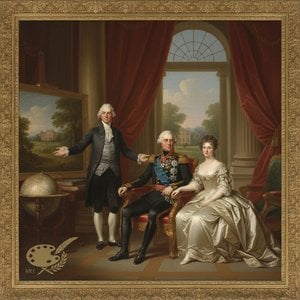
Painting Of Arthur, Prince Of Wales Son Of Henry Vii
Ver más…
Art period: Contemporáneo
Works on APS: 5
Born: 1970, Reino Unido
A Life Reclaimed: The Remarkable Story of John Carter
Born in the quiet Essex town of Coggeshall in 1815, John Carter’s life was initially marked by the humble existence of a silk weaver. His early years offered little indication of the artistic path he would ultimately forge. Attending local schools – first the infants' school on Church Street, then the parish national school, and finally the endowed school founded by Sir Robert Hitcham – Carter displayed no particular aptitude for art, though he harbored a childhood fondness for sketching in his books and even upon the walls of his home. This nascent inclination remained largely undeveloped until fate intervened with devastating force. A youthful indiscretion, a climb for bird’s eggs after an evening spent drinking at the local public house, resulted in a fall from a height of forty feet in May 1836. The impact shattered his cervical vertebrae, leaving him paralyzed from the neck down, yet miraculously alive. This catastrophic accident didn't extinguish Carter’s spirit; instead, it ignited within him an extraordinary determination to reclaim agency over his life through art.
From Silk Weaver to Master Draftsman
The initial prognosis was grim. Doctors considered his survival itself a medical marvel, documenting his case in publications like *The Lancet* years after his death as “the most remarkable…with which we are acquainted.” Confined to immobility, Carter’s world narrowed dramatically. He relied entirely on others for care and found solace in religion, having previously drifted from faith. It was approximately a year after the accident that he discovered inspiration in an unexpected source: the story of Elizabeth Kinning, an asylum inmate who had learned to paint using her mouth. Emulating her example, Carter began to teach himself to draw and paint, holding a pencil firmly between his lips. He worked on slates and paper pinned to his pillow, painstakingly developing a skill that defied his physical limitations. His dedication was unwavering, resulting in work of astonishing precision and detail. He created a specially adapted desk to facilitate his artistic endeavors, relying on assistants to provide materials. Carter’s technique wasn't merely about overcoming disability; it was about achieving genuine artistic mastery.
Influences and Artistic Style
Carter’s artistic vision drew heavily from the masters of European art—particularly Albrecht Dürer, Raphael, Rembrandt, Van Dyke, and Landseer. He meticulously studied their techniques, absorbing their understanding of perspective, anatomy, and chiaroscuro (the dramatic use of light and shadow). Like these titans of painting, Carter sought to capture the essence of his subjects with unwavering realism, striving for accuracy and emotional resonance. His drawings were characterized by an extraordinary power of imitation—a skill that earned him the admiration of fellow artists like George Richmond. As Richmond eloquently remarked, Carter’s work demonstrated “that creativity knows no bounds,” capturing the beauty and complexity of the natural world with breathtaking fidelity. He achieved this remarkable feat despite his physical limitations, proving that artistic expression could flourish even in circumstances deemed impossible by conventional standards.
Major Achievements and Recognition
Carter's most celebrated original artwork—"A Ratcatcher and His Dogs"—became an instant sensation upon its completion in 1849. The painting garnered widespread acclaim, securing a place among the finest examples of animal drawing ever produced. Critically lauded for its meticulous detail and masterful composition, it captivated audiences and cemented Carter’s reputation as one of Britain's foremost artists. Furthermore, his work was recognized by luminaries like Edwin Landseer, who declared it “the most remarkable” he had ever witnessed—a testament to Carter’s unparalleled talent and unwavering dedication. Perhaps the most poignant symbol of Carter’s artistic triumph was Queen Victoria herself acquiring a copy of this masterpiece—a gesture that underscored its enduring beauty and significance. His legacy extends beyond his artistic accomplishments; he stands as an inspirational figure who embodies resilience, determination, and the transformative power of art.
Historical Significance
John Carter's story transcends mere biographical detail; it represents a profound statement about human potential and the ability to overcome adversity. He exemplifies the spirit of Victorian ingenuity—a refusal to succumb to limitations imposed by circumstance—and his artistic achievements serve as a beacon of hope for anyone facing challenges in their own lives. His unwavering faith, coupled with his extraordinary skill in drawing and painting using his mouth, captivated the public imagination and solidified his place in art history. He remains an important figure whose story continues to inspire awe and admiration, reminding us that creativity—true artistic mastery—can flourish even within the most restrictive of conditions. His tale underscores the enduring power of human spirit.
Por el equipo editorial de WahooArt.com
Cuestionario de arte
Cada pregunta tiene una única respuesta correcta.
Pregunta 1:
¿Cuál fue el evento significativo que impulsó a John Carter a comenzar creando arte usando su boca?
Pregunta 2:
¿Antes de convertirse en artista, cuál era la profesión de John Carter?
Pregunta 3:
¿Qué famoso artista comentó sobre el extraordinario poder de imitación en el trabajo de Carter?
Pregunta 4:
¿Cuál era el título de la obra más aclamada original de John Carter, incluso adquiriendo una copia por Reina Victoria?
Pregunta 5:
¿Qué motivó a John Carter a volver hacia la religión después del accidente?
Descubre las 25 obras maestras de John Constable, el pintor romántico inglés que capturó la belleza del paisaje. Explora su técnica, historia y significado en WahooArt.com. Reproducciones de arte de alta calidad para tu hogar.
Descubre 10 obras maestras del siglo XIX: Monet, Goya y más. Explora el impresionismo, realismo y romanticismo que definieron una época. Encuentra reproducciones de arte exclusivas para decorar tu hogar con estilo en WahooArt.com.
Explore the life & work of John Hoppner, a leading Georgian portraitist. Discover his vibrant style, influential patrons, and lasting impact on British art history. Expert insights for collectors.
¡Hola! Puedo ayudarte a elegir una obra de arte, realizar el seguimiento de un pedido o resolver tus dudas sobre la garantía. ¿En qué puedo ayudarte hoy?