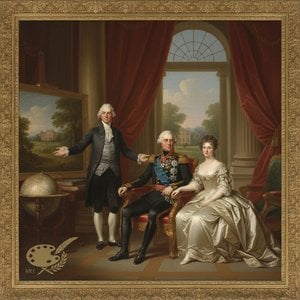
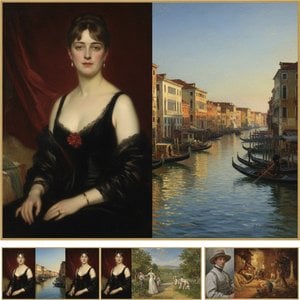
John Butler Yeats: Bridging Tradition and Modernity
John Butler Yeats (1839–1922) stands as a singular figure in Irish art history—a painter who simultaneously embraced the meticulous realism of his formative years and yielded to the expressive dynamism of Expressionism, forging a path that bridged the gap between Victorian academic painting and the burgeoning modernist movement. Born into an Anglo-Irish family steeped in tradition, Yeats’s artistic journey began with a grounding in classical technique, honed at Trinity College Dublin and nurtured by influential mentors like John Kells Ingram—a connection to the intellectual currents of his time that would permeate his entire oeuvre. Yet, he refused to confine himself to established conventions, seeking inspiration from the vibrant landscapes of Sligo and engaging deeply with the mystical traditions of Ireland—influences that profoundly shaped his artistic vision.Early Years and Artistic Training: The Seeds of Innovation
Yeats’s upbringing instilled in him a dual sensibility—a respect for scholarly pursuits alongside an innate fascination with visual art. Unlike many of his peers, he eschewed the rigid religious dogma prevalent at Trinity College, prioritizing intellectual curiosity and embracing a worldview informed by both science and philosophy. His father, William Butler Yeats, was a clergyman who nevertheless championed artistic endeavors, recognizing their importance in fostering creativity and imagination—a conviction that would resonate throughout Yeats’s life. This familial ethos fostered an environment conducive to artistic exploration, propelling him toward the Heatherley School of Fine Art in London where he honed his skills under the tutelage of influential instructors. It was there that he encountered fellow artists like John Henry Foley and Richard Doyle—men who championed Impressionism and encouraged him to experiment with new techniques. These formative experiences cemented Yeats’s commitment to artistic innovation, laying the groundwork for his groundbreaking stylistic evolution.From Landscapes to Portraits: A Shift Towards Expression
Yeats initially gained renown as an illustrator and watercolorist, capturing the beauty of Irish landscapes with meticulous detail—a style heavily influenced by Romanticism. His early paintings are characterized by a serene palette and a careful observation of natural forms, reflecting his deep connection to the Sligo countryside. However, around 1906 Yeats embarked on a transformative artistic journey, embracing Expressionism—a movement that prioritized emotional intensity over objective representation. This stylistic shift marked a decisive break from academic tradition, aligning him with artists like Edvard Munch and Oskar Kokoschka who sought to convey inner psychological states through bold colors and distorted forms. His portraits emerged as a testament to this newfound expressive freedom, capturing the essence of his subjects—often conveying subtle nuances of emotion and character—with remarkable sensitivity.Notable Works and Recognition: A Legacy Enduring Through Time
Yeats’s artistic output spanned decades, producing an impressive catalog of paintings that continue to captivate audiences today. Among his most celebrated works are *Hester Dowden as a Child*, *Violet Osborne*, *George Moore*, and *The Liffey Swim*—each piece embodying the stylistic hallmarks of Expressionism while simultaneously reflecting Yeats’s profound understanding of human psychology. His landscapes, particularly those depicting Sligo, remain iconic representations of Irish scenery—infused with lyrical beauty and imbued with symbolic resonance. He achieved international acclaim for his artistic achievements, securing a place among Ireland's most distinguished painters. Furthermore, he was awarded the Olympic Medal for Painting at the Paris Games in 1924—a testament to his enduring legacy as an artist recognized on a global scale. His influence extended beyond his own paintings, shaping the aesthetic sensibilities of subsequent generations of Irish artists and cementing his place as a pivotal figure in the history of modern Irish art. ## Beyond Technique: Yeats's Artistic Vision and Influence John Butler Yeats’s artistic vision transcended mere technical proficiency; it was rooted in a deep engagement with philosophical ideas and spiritual traditions—particularly those originating from Ireland. He sought to capture not just what he saw but also what he felt—translating inner experience into visual form through bold colors, expressive brushstrokes, and evocative compositions. His work embodies the spirit of Romanticism alongside Expressionism, reflecting his intellectual curiosity and artistic experimentation. Yeats’s legacy extends far beyond his individual paintings—he fostered a creative environment within his family, encouraging each member to pursue their artistic passions. He championed Irish art and culture, establishing Dun Emer Industries and Cuala Press—institutions that played an important role in promoting artistic innovation. His influence resonated throughout the Irish Arts and Crafts movement, shaping the aesthetic sensibilities of artists who followed him—a testament to his enduring contribution to the cultural landscape of Ireland. His paintings continue to inspire admiration for their beauty, sensitivity, and profound psychological insight—solidifying John Butler Yeats’s position as one of Ireland's most important artistic figures.Preguntas y respuestas
¿Dónde puedo encontrar estadísticas sobre las obras de John Butler Yeats?
La página de Estadísticas de John Butler Yeats presenta estadísticas calculadas a partir de las obras del artista listadas en este sitio web.
¿De dónde es John Butler Yeats?
John Butler Yeats nació en Reino Unido.
¿En qué movimientos trabajó John Butler Yeats?
Las obras de John Butler Yeats pueden explorarse por movimiento en la página de Todos los movimientos del artista.