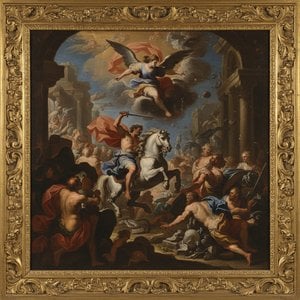
A Legacy of Light: The Life and Art of Johann Michael Rottmayr
Johann Michael Rottmayr (1654-1730) stands as a pivotal figure in the transition from the High Baroque to the Rococo styles in Central Europe. He wasn’t merely a painter; he was a conduit, skillfully channeling the vibrant energy of Italian Renaissance masters through the lens of burgeoning Austrian artistic sensibilities. Rottmayr's journey began within a family already touched by artistry, providing fertile ground for his innate talents to blossom. His formative years were spent in Lauf an der Pegnitz, Germany, where he received his initial artistic training under Johann Carl Loth in Venice – a period that instilled within him a profound appreciation for the techniques and aesthetics of Venetian Renaissance painters. Loth’s tutelage wasn't simply about mastering brushstrokes; it was immersing Rottmayr in the world of Titian, Veronese, and Tintoretto, fostering an understanding of coloristic richness, dramatic composition, and masterful use of light and shadow – elements that would permeate his entire artistic career.From Venetian Roots to Salzburg Patronage
This Venetian influence remained a cornerstone of Rottmayr’s style throughout his life. He wasn't alone in absorbing Italian influences; Hans Adam Weissenkircher, a contemporary from Lauf, also brought these artistic currents northwards, fostering a shared aesthetic dialogue that enriched the region’s art scene. Following Loth’s guidance, Rottmayr embarked on a path of independent exploration and experimentation, honing his skills and developing his distinctive vision. His artistic ambitions soon attracted the attention of influential patrons, notably Prince-Bishop Maximilian Franz von Thun und Hohenlohe in Salzburg – securing him a prestigious position as the general painter to the Bishopric. This patronage afforded Rottmayr unparalleled opportunities for creative fulfillment and established his reputation within Salzburg’s aristocratic circles. He flourished under Thun’s support, undertaking ambitious projects that showcased his growing mastery of technique and composition. Notably, he collaborated closely with Johann Bernhard Fischer von Erlach on Schloss Frain an der Thaya (now Vranov nad Dyjí), creating a harmonious architectural ensemble where Rottmayr's frescoes seamlessly integrated with the building’s design – demonstrating his commitment to synthesizing artistic disciplines.The Sublime Ceiling: Melk Abbey and Artistic Innovation
Rottmayr’s most celebrated achievement undoubtedly resides in the monumental fresco adorning the central dome of Melk Abbey, Austria. Completed between 1698 and 1703, this masterpiece represents a pinnacle of Baroque illusionistic painting and embodies Rottmayr's unparalleled command of perspective and color theory. The scene depicts a breathtaking vision of heaven – swirling clouds illuminated by radiant light, populated by angelic figures and saints – transforming the abbey’s interior into an ethereal realm of divine splendor. This ambitious undertaking required meticulous planning and execution, reflecting Rottmayr’s dedication to pushing the boundaries of artistic innovation. It cemented his place as one of Austria's foremost Baroque painters and continues to inspire awe in visitors today. Beyond Melk Abbey, Rottmayr produced numerous significant works across Austria and Germany, including frescoes for Karlskirche in Vienna – notably *Intercession of Charles Borromeo supported by the Virgin Mary*, which exemplifies his masterful use of dramatic lighting and emotive color palettes.A Synthesis of Styles: Rottmayr’s Artistic Contribution
Rottmayr wasn't merely replicating Italian artistic conventions; he was adapting them, infusing them with a distinctly Austrian character. His paintings embody a dynamic interplay of light and shadow, vibrant colors, and dramatic composition – hallmarks of the Baroque aesthetic. However, his explorations extended beyond mere stylistic imitation; Rottmayr demonstrated a growing sensitivity to form and detail, foreshadowing the elegance and refinement of the Rococo period. He skillfully blended Venetian influences with Austrian traditions, creating artworks that transcended stylistic boundaries and cemented his legacy as a pivotal figure in European art history. His influence resonated throughout subsequent generations of artists, shaping the artistic landscape of Austria and beyond.A Lasting Impression: Rottmayr’s Enduring Legacy
Johann Michael Rottmayr died peacefully in Vienna on October 25th, 1730, leaving behind a remarkable body of work that continues to captivate audiences worldwide. His frescoes, ceiling paintings, and architectural collaborations stand as enduring monuments to his artistic genius – testament to his unwavering dedication to craftmanship and his profound understanding of the expressive potential of visual art. Rottmayr’s legacy extends beyond the beauty of his creations; it resides in his role as a bridge between eras—a conduit for transmitting Italian Renaissance ideals into the burgeoning Baroque style of Central Europe. He is rightfully considered one of Austria's most important painters of the late 17th and early 18th centuries, securing his place among the artistic luminaries of his time. His work continues to inspire admiration and scholarly study—a testament to its enduring power and significance in the history of art.Preguntas y respuestas
¿Qué estados de ánimo expresan las obras de Johann Michael Rottmayr?
La Galería de estados de ánimo de Johann Michael Rottmayr es una página que organiza las obras del artista según el estado de ánimo.
¿Qué tan populares son las obras de Johann Michael Rottmayr?
Existe una página de Estadísticas para Johann Michael Rottmayr, que presenta estadísticas sobre las obras del artista en este sitio web.
¿En qué ciudad y país nació Johann Michael Rottmayr?
Johann Michael Rottmayr nació en Lauf an der Pegnitz, en Alemania.