Jan Jakub Twardowski (June 1, 1915 – January 18, 2006) stands as a singular figure in Polish religious poetry of the mid-twentieth century. Born in Warsaw during the tumultuous years of World War I, his life’s trajectory intertwined with Catholicism and a profound appreciation for the natural world—a connection that would permeate his poetic output. He wasn't a grand orator or a celebrated intellectual; rather, Twardowski achieved renown through remarkably concise verses imbued with warmth, humor, and an uncanny ability to capture the essence of everyday experience.
His formative years were marked by displacement following the war’s devastation, relocating his family to Russia before returning to Warsaw in 1932. He completed his secondary education in 1935, laying the groundwork for a life dedicated to both faith and artistic expression. This early exposure to hardship instilled within him a sensitivity to human suffering—a characteristic that would inform his poetic vision throughout his career.
Twardowski's poetic style distinguished itself from prevailing trends of the time. Rejecting elaborate metaphors and complex philosophical pronouncements, he favored directness—speaking plainly about God’s presence in simple moments: tending a garden, sharing a meal with family, observing the changing seasons. This stylistic choice wasn’t merely economical; it reflected his belief that true spirituality resided not in abstract contemplation but in attentive engagement with the tangible realities of existence. He skillfully blended observations of nature—particularly birdsong and wildflowers—with reflections on faith, creating poems that resonated deeply with a generation grappling with uncertainty and searching for solace. His work embodies a humanist ethos, prioritizing compassion and recognizing the sacredness inherent in ordinary human relationships.
Among his most celebrated pieces is “Violanki,” a poignant meditation on the beauty and fragility of life symbolized by birdsong. This poem exemplifies Twardowski’s signature approach—a delicate balance between lyrical imagery and philosophical contemplation. The poem's evocative descriptions of dawn, dew-kissed petals, and avian melodies capture not only visual splendor but also an underlying sense of wonder and reverence for the divine order. It is considered a cornerstone of Polish religious poetry, demonstrating how profound spiritual insight can emerge from humble observation.
Influenced by thinkers like Marcel Proust and Aleksandr Blok—whose explorations of memory and emotion mirrored Twardowski’s own artistic sensibilities—he nevertheless maintained an independent voice rooted in Polish vernacular culture. He embraced colloquialisms and humor, injecting a refreshing spontaneity into his verses that distinguished him from more formal poetic traditions. This stylistic boldness wasn’t accidental; it underscored his conviction that faith could be expressed authentically through the language of ordinary people—a perspective that cemented his position as a champion of accessible spirituality.
His legacy resides in his unwavering commitment to portraying faith with humility and sensitivity. He demonstrated that profound spiritual insight could emerge from the simplest observations, leaving behind a body of work that continues to inspire readers seeking beauty and truth within the commonplace. Twardowski passed away peacefully in 2006, leaving behind a testament to the enduring power of poetry—a reminder that even the most unassuming expressions can convey the deepest truths about human experience and divine presence. He remains one of Poland’s foremost voices in contemporary religious lyricism, securing his place as an artist who elevated the everyday into something extraordinary.
Explore the profound beauty of Lyrical Abstraction. Discover how master artists use color, flow, and impasto texture to evoke deep emotion, offering sophisticated insights for discerning art collectors seeking to enrich their collections with evocative, modern masterpieces.
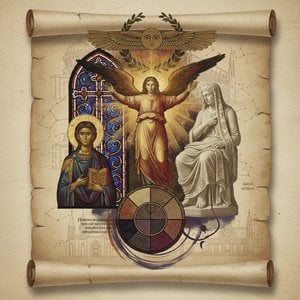
Explore the profound impact of spiritual themes in fine art. From Renaissance iconography to Baroque drama, discover how sacred symbolism and divine visions have shaped art history through a scholarly and reflective lens.
Explore the profound power of religious symbolism in art history. From Renaissance masterpieces to sacred iconography, uncover the hidden meanings behind divine details in a deep dive into classical art excellence.
¡Hola! Puedo ayudarte a elegir una obra de arte, realizar el seguimiento de un pedido o resolver tus dudas sobre la garantía. ¿En qué puedo ayudarte hoy?