Museums on APS: Museo de Instrumentos Musicales Folklóricos en Szydłowiec
Nationality: Polonia
Top 3 works:
Violin with a bow
Violin- resonant box
Ver más…
Copyright status: Under copyright
Also known as: Jan Rafalski
Born: 1947, Poznań, Polonia
Art period: Edad Moderna
Jan Antoni Rafalski: Bridging Science and Artistic Vision
Jan Antoni Rafalski, born in Poznań, Poland, in 1947, stands apart as an artist whose artistic endeavors are inextricably linked to his scientific background—a harmonious fusion that distinguishes him from many of his contemporaries. While perhaps not universally recognized outside specialist circles, Rafalski’s unwavering devotion to portraying musical instruments, particularly violins, has garnered considerable acclaim within the Polish art community and firmly established him as a singular voice in contemporary artistic expression.
His intellectual journey commenced with rigorous academic pursuits at Poznań University (Chemistry), followed by doctoral studies at Yale University (PhD). This profound grounding in scientific principles—specifically molecular biology—doesn’t merely inform his artistic practice; it fundamentally shapes his worldview, fostering an acute awareness of structure, material properties, and the subtle dance between light and shadow. These observations translate directly into his paintings, elevating them beyond mere visual representation to convey a deeper understanding of their essence. Unlike artists who gravitate towards abstract expressionism or conceptual art, Rafalski maintains a steadfast focus on meticulous observation and faithful depiction—a deliberate choice that underscores his commitment to artistic integrity.
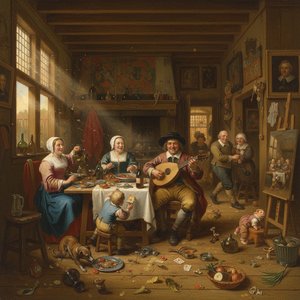
Rafalski’s fascination with musical instruments began early in life, recognizing their inherent sculptural beauty alongside their complex acoustic characteristics. Driven by this passion, he embarked upon ambitious projects dedicated to documenting violins with unprecedented detail. His technique is characterized by a masterful layering of glazes and pigments—a painstaking process achieved through meticulous brushwork that captures the subtle nuances of wood grain and varnish sheen. He deliberately employs a palette rooted in muted earth tones—ochres, siennas, umbers—creating canvases imbued with an atmosphere reminiscent of Northern Renaissance masters—artists who similarly excelled at capturing light and texture with remarkable precision.
A significant portion of Rafalski’s professional life was spent at DuPont Nemours, where he honed his analytical skills alongside artistic exploration. This dual engagement provided him with invaluable perspectives on both scientific rigor and creative innovation. His work has been showcased internationally, demonstrating a dedication to sharing his artistic vision with a global audience. Critically acclaimed for his ability to synthesize disparate disciplines—science and art—Rafalski’s legacy resides in his unwavering commitment to preserving and celebrating the beauty of musical instruments through exquisitely rendered paintings – artworks that honor both intellect and imagination.
Notable Achievements: Rafalski's meticulous approach has earned him recognition within academic circles and cemented his reputation as a distinctive figure in Polish art.
Influences: His artistic style draws inspiration from Rembrandt and Vermeer, artists who similarly mastered the art of capturing light and texture with exceptional accuracy.
Further Information: You can explore Rafalski’s work on platforms like WahooArt.com and discover similar artists' styles at /es/artists/jan-van-kessel-el-mayor/. Also, delve into the artistic heritage of Poland with masterpieces such as “Los Hijos del Planeta Mercurio” by Jan Brueghel (II) at /es/art/jan-brueghel-el-viejo-los-hijos-del-planeta-mercurio-jan-brueghel-ii-D37CM7-es/ and “Retrato de Margarita van Eyck (Sra. Jan van Eyck)” by Jan van Eyck at /es/art/jan-van-eyck-retrato-de-margarita-van-eyck-sra-jan-van-eyck-9H5QCN-es/.
Explore the life & art of Jan Steen, a leading Dutch Golden Age painter renowned for his humorous genre scenes & insightful social commentary. Discover his techniques, legacy, and collecting tips.
Explore the powerful historical paintings of Jan Matejko, Poland's national artist. Discover his iconic works & learn how he shaped Polish identity in the 19th century. High-quality reproductions available.
Explore the life & work of Stanisław Wyspiański, a pivotal figure in Polish Symbolism and the Young Poland movement. Discover his iconic paintings, dramas, and stained glass designs reflecting national identity & artistic innovation.
¡Hola! Puedo ayudarte a elegir una obra de arte, realizar el seguimiento de un pedido o resolver tus dudas sobre la garantía. ¿En qué puedo ayudarte hoy?