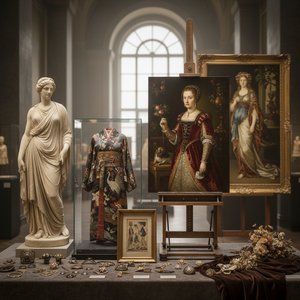
James Tissot: A Parisian Impressionist Capturing Victorian Life
James Jacques Joseph Tissot (1836-1902) stands as a singular figure in Victorian art, renowned for his exquisitely detailed depictions of Parisian society and biblical narratives. Born in Nantes, France, to Marcel Théodore tissot, a drapery merchant, and Marie Durand, whose design skills extended to hats—a testament to the collaborative spirit of their family—Tissot’s upbringing instilled a deep Catholic faith that profoundly shaped his artistic vision. His early fascination with seafaring, likely stemming from his father's profession, foreshadowed recurring motifs of ships and boats in his later oeuvre.
Early Artistic Training: Tissot’s ambition to pursue painting propelled him to Paris around 1854, where he adopted the Anglicized name “James,” possibly influenced by his burgeoning interest in English culture. He enrolled at the École des Beaux-Arts under Jean-Auguste-Dominique Ingres and Louis Lamothe—both prominent Lyonnaise painters who sought Parisian instruction—benefiting immensely from Lamothe’s guidance. Lamothe recognized Tissot's talent early on, fostering a mentorship that proved instrumental in shaping his artistic development. This formative relationship instilled in him a dedication to meticulous observation and technical mastery – qualities that would define his entire career.
The Louvre Method: Like many aspiring artists of his era, Tissot honed his skills by meticulously copying works at the Louvre Museum. This disciplined approach allowed him to absorb stylistic nuances and develop a masterful command of technique. The Louvre served as an invaluable laboratory for young painters, exposing them to the grandeur of classical sculpture and the innovations of Impressionism. Tissot’s unwavering commitment to this practice ensured that he remained abreast of artistic trends while cultivating his own distinctive visual language.
Parisian Society and Genre Painting: Tissot swiftly established himself as a celebrated painter of Parisian life, capturing the elegance and bustle of Victorian society with unparalleled precision. His canvases overflowed with richly dressed women engaged in various activities—shopping, dining, entertaining—presented with meticulous attention to costume and setting. He skillfully blended Impressionistic influences with Japonisme, incorporating decorative patterns and compositional techniques borrowed from Japanese prints into his paintings. This fusion resulted in a distinctive visual language that conveyed both beauty and social commentary. Nota His depictions of Parisian women – particularly those involved in fashionable pursuits – are considered among the finest examples of Victorian genre painting.
Biblical Narratives: Beyond his portrayals of urban life, Tissot passionately pursued biblical subjects, producing a series of monumental paintings that explored themes of faith, morality, and redemption. His ambitious undertaking to illustrate the Gospels earned him considerable acclaim and solidified his position as one of the foremost artists of his time. He approached these narratives with meticulous scholarship and artistic sensitivity, striving to convey spiritual truths through evocative imagery. Notable works include “The Last Supper” and “The Nativity,” which stand as testaments to his ability to transform religious stories into emotionally resonant visual experiences.
Technique and Legacy: Tissot’s technique was characterized by layering thin glazes of oil paint—a hallmark of Impressionism—to achieve luminous colors and subtle tonal variations. He employed mezzotint engraving alongside painting, further expanding his artistic repertoire. His meticulous attention to detail and masterful blending of styles established a precedent for realism and decorative artistry that continues to inspire artists today. James Tissot’s legacy resides not only in his iconic paintings but also in his profound influence on the aesthetic sensibilities of Victorian England and beyond—a painter who captured the spirit of his time while simultaneously elevating biblical narratives to new heights of expressive power.