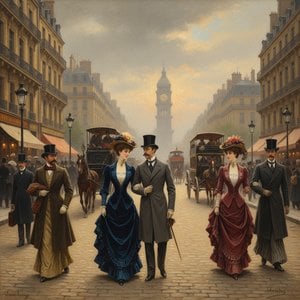
James Jacques Joseph Tissot (1836-1902): Un visionario victoriano que unió el realismo y el impresionismo
James Jacques Joseph Tissot, nacido el 15 de octubre de 1836 en París, Francia, fue un pintor prolífico cuya carrera se extendió durante décadas, consolidando su lugar como uno de los artistas más celebrados de la era victoriana. Aunque inicialmente se formó como arquitecto, Tissot abandonó rápidamente este camino por el cautivador encanto de la pintura, dedicándose a capturar la grandeza y las complejidades de la sociedad parisina junto a profundas narrativas bíblicas. Su estilo distintivo —una magistral mezcla de realismo y técnicas impresionistas— continúa fascinando tanto a historiadores del arte como a coleccionistas por igual.- Primeros años y formación artística: Los años formativos de Tissot estuvieron marcados por una crianza privilegiada dentro de una familia adinerada, lo que le permitió acceder a una instrucción artística excepcional. Estudió arquitectura en la École Polytechnique antes de transicionar al dibujo bajo la tutela de Alexandre Cabanel y Jean-Léon Gérôme, absorbiendo las influencias estilísticas del realismo académico predominante en su época. Estas experiencias fundacionales le inculcaron una atención meticulosa al detalle y un enfoque disciplinado de la composición, rasgos que caracterizarían toda su obra.
- París victoriano y el retrato social: El gran salto artístico de Tissot llegó con sus representaciones de la vida parisina durante la Belle Époque. Documentó meticulosamente escenas de teatros, casas de ópera y reuniones elegantes, capturando no solo el esplendor visual, sino también los sutiles matices del comportamiento social. Sus lienzos —como “El sombrero de Rubens” y “La hora del té”— se convirtieron en representaciones icónicas de la elegancia y sofisticación victoriana, reflejando las ansiedades y aspiraciones de una sociedad en rápido cambio.
- Narrativas bíblicas y composición dramática: Más allá de los paisajes urbanos, Tissot destacó en la representación de historias bíblicas con una teatralidad notable. Abordó estas narrativas con un compromiso inquebrantable hacia la precisión histórica, combinado con una pincelada expresiva —sello distintivo del impresionismo—, creando imágenes emocionalmente resonantes que cautivaron al público. Entre sus obras más destacadas se encuentran “El hallazgo del Santo Grial” y “La última cena”, que demuestran su capacidad para transmitir profundidad espiritual junto a un dinamismo visual asombroso.
- Técnica y evolución artística: La técnica artística de Tissot evolucionó considerablemente a lo largo de su carrera. Aunque inicialmente favorecía el realismo académico, adoptó gradualmente las influencias impresionistas, experimentando con pinceladas más sueltas y capturando momentos fugaces de luz y color. Este cambio estilístico le permitió dotar a sus pinturas de una sensación palpable de atmósfera y emoción, alejándose de la formalidad estática de sus primeros trabajos.
- Legado y trascendencia histórica: Jacques Joseph Tissot falleció el 8 de agosto de 1902, dejando tras de sí un impresionante cuerpo de obra que sigue inspirando admiración. Sus pinturas se encuentran en destacados museos de todo el mundo, incluyendo la Bibliothèque Nationale Centrale y el Museo Getty, testimonio de su perdurable legado artístico. Más allá de simplemente documentar su época, Tissot elevó la pintura a una forma de narración: una poderosa mezcla de observación e imaginación que consolidó su posición como uno de los artistas más influyentes del periodo victoriano.
Exploración adicional
Puede profundizar en el viaje artístico de Tissot visitando estos recursos:- James Tissot - Wikipedia:https://en.wikipedia.org/wiki/James_Tissot
- Jacques Joseph Tissot - Museo Getty:https://www.getty.edu/art/collection/person/103KY1
- Jacques Joseph Tissot: Una crónica de la vida parisina y evolución narrativa:/en/articles/jacques-joseph-tissot-a-chronicle-of-parisian-life-narrative-evolution-en/
- James Tissot (1836-1902), Ambiguamente moderno | Musée d’Orsay:https://www.musee-orsay.fr/en/whats-on/exhibitions/presentation/james-tissot-1836-1902-ambiguously-modern
Preguntas y respuestas
¿En qué periodo histórico trabajó Jacques Joseph Tissot?
Jacques Joseph Tissot trabajó durante el periodo Siglo XIX. Este periodo sitúa la actividad del artista en la historia.
¿Existe una cronología de las obras de Jacques Joseph Tissot?
Existe una cronología de las obras de Jacques Joseph Tissot: la página Cronología de obras del artista ordena las obras por fecha de creación.
¿Dónde puedo ver el perfil cromático de la obra de Jacques Joseph Tissot?
El uso del color de Jacques Joseph Tissot en las obras listadas en este sitio web puede estudiarse en la página Genoma de la Paleta del artista.