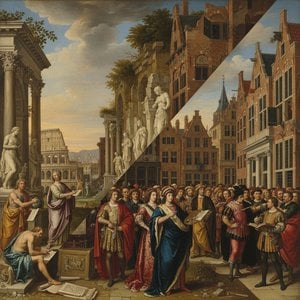
Jacopo Francia (Raibolini): A Bolognese Renaissance Visionary
Giacomo Raibolini, also known as Jacopo Francia or Giacomo Francia, was an Italian painter and printmaker born in Zola Predosa around 1486. He died in Bologna in 1557. Not much is known about his early life and training, but he emerged as one of the most prominent artists in Bologna during the sixteenth century—a period marked by artistic innovation and humanist ideals. His distinctive style skillfully blended elements from the Venetian school with those of the emilian tradition, resulting in a singular aesthetic characterized by both elegance and naturalism. Francia’s legacy extends beyond mere visual beauty; he embodies the spirit of his time, reflecting its intellectual curiosity and artistic ambition.
Early Life & Training: The Seeds of Genius
Precise details regarding Francia's formative years remain elusive. Records indicate that he was the son of Francesco Raibolini, a wealthy Bolognese merchant who fostered an appreciation for art within the family. While biographical information is scarce, it’s believed he received training primarily in Bologna and possibly Venice, absorbing influences from masters like Andrea Mantegna and Giovanni Bellini—figures whose meticulous observation of nature and mastery of perspective would profoundly shape Francia's artistic approach. These formative years instilled a deep understanding of humanist principles and fueled his lifelong dedication to capturing the essence of human experience through art.
Style & Technique: Harmonious Balance Between Venetian Luminosity and Emilian Accuracy
Francia’s artistic style is instantly recognizable for its refined draughtsmanship and harmonious composition. He championed the Venetian tradition’s emphasis on luminous color palettes and atmospheric effects, yet tempered it with the emilian penchant for anatomical accuracy and detailed rendering of drapery—a combination that produced images imbued with both grace and realism. This masterful blend elevated his work beyond mere imitation; it represented a conscious effort to synthesize disparate artistic traditions into a cohesive visual language. His favored medium was drypoint etching, a technique he perfected to achieve astonishing tonal gradations through subtle scratching onto copper plates. This meticulous process allowed him to capture nuanced expressions and textures, elevating his prints to masterpieces of artistic subtlety. The resulting images resonated with an unparalleled level of psychological depth—a hallmark of Francia’s distinctive style.
Notable Paintings: Expressions of Faith and Human Emotion
Francia’s oeuvre comprises numerous paintings spanning diverse genres—religious commissions dominated his output, reflecting the fervent piety of Bolognese society. Among his most celebrated works are altarpieces depicting saints and biblical scenes, executed with breathtaking detail and imbued with spiritual fervor. He also produced frescoes adorning churches throughout Bologna, demonstrating his ability to transform architectural spaces into immersive narratives of faith. These paintings stand as testament to Francia’s profound understanding of human emotion and his unwavering commitment to conveying the sacred through visual artistry.
Portraiture & Psychological Insight: Capturing the Soul Within Form
Francia’s reputation rests particularly on his portraits—a genre where he achieved unparalleled psychological depth. Unlike many of his contemporaries who prioritized idealized representations, Francia sought to capture the essence of his subjects' personalities through subtle gestures and expressions. His portraits are considered among the finest examples of Renaissance portraiture, revealing not merely physical likeness but also inner character and emotional nuance. He skillfully utilized chiaroscuro—the dramatic interplay between light and shadow—to sculpt form and convey psychological states with remarkable precision.
Legacy & Influence: An Enduring Resonance Across Centuries
Jacopo Francia’s artistic achievements cemented his place as a pivotal figure in Bolognese art history. He served as an inspiration for subsequent generations of painters who adopted his stylistic principles—particularly the meticulous attention to detail and the expressive use of tonal gradation. His work continues to resonate with scholars and artists alike, demonstrating the enduring power of Renaissance artistry to convey profound human emotion and intellectual contemplation. Francia’s legacy extends far beyond his own lifetime, securing his position as one of the most influential painters of the sixteenth century—a testament to his artistic genius and its lasting impact on Western art history.