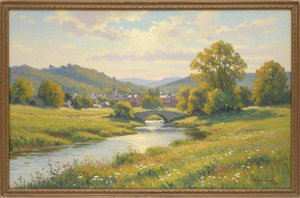
Henry Bayley Snell: A Pioneer of American Impressionism
Henry Bayley Snell (September 29, 1858 – January 17, 1943) stands as a pivotal figure in the burgeoning landscape and marine painting movement that defined early twentieth-century America. Born in Richmond, England, Snell’s journey to artistic prominence began with formative years spent studying at the Art Students League of New York—a crucible for absorbing the stylistic innovations sweeping across Europe—before embarking on a transatlantic voyage that irrevocably shaped his creative vision. His emigration solidified his connection to the United States and propelled him into an influential role as educator, fostering the talents of future luminaries within the Philadelphia Ten.
Early Life & Education: Seeds of Observation
Snell’s upbringing instilled in him a deep appreciation for observation and meticulous detail—qualities that would become hallmarks of his artistic practice. Growing up in Richmond fostered a sensitivity to nuance and an understanding of how light transforms surfaces, shaping his innate inclination toward capturing the subtleties of the natural world. Studying at the Art Students League provided invaluable exposure to Impressionist techniques championed by artists like Claude Monet and Pierre-Auguste Renoir, immersing him in the revolutionary ideas circulating amongst European painters. This immersion directly influenced Snell’s approach to portraying fleeting moments of light and color—a core principle of Impressionism that would permeate his entire oeuvre.
Maritime Visions & The Photoengraving Company: Mastering Atmospheric Perspective
Snell’s early career found him employed by the Photoengraving Company in New York City, where he honed his skills in producing marine scenes—a genre that would become synonymous with his artistic identity. This experience wasn't merely about replicating visual appearances; it demanded a profound understanding of tonal gradations and atmospheric perspective—techniques perfected by Impressionists to convey the illusion of depth and luminosity. Snell skillfully integrated these principles into his paintings, creating landscapes imbued with an ethereal quality that captured the essence of coastal environments. He meticulously studied the interplay between light and shadow, mirroring Monet’s dedication to capturing the ephemeral beauty of water surfaces.
Marriage & Teaching at Philadelphia School for Women: Cultivating Artistic Talent
Snell married Florence Francis in 1888, establishing a stable domestic life alongside his burgeoning artistic pursuits—a partnership that nurtured both personal happiness and creative collaboration. Recognizing the importance of nurturing talent within the next generation, he accepted a professorship at the Philadelphia School of Design for Women (now Moore College of Art and Design) in 1899—a position he held until his death—inspiring countless aspiring artists to embrace observation and experimentation. Snell’s influence extended beyond imparting technical skills; he instilled in his students a passion for artistic expression rooted in genuine engagement with the natural world, mirroring the ethos of Impressionist ateliers.
The Philadelphia Ten & Artistic Legacy: Shaping Regional Aesthetics
Snell's contribution to American art extended beyond individual masterpieces; he profoundly impacted the artistic landscape through his mentorship and association with the Philadelphia Ten—a group of influential painters who championed a distinctly regional aesthetic. Among these students were Theresa Bernstein, whose work would become celebrated for its expressive use of color and form. Snell’s guidance instilled in them a commitment to capturing the beauty of Pennsylvania’s landscapes—particularly those illuminated by the golden light of autumn—establishing a legacy that continues to resonate within the Philadelphia art community. His dedication to fostering creativity and promoting artistic dialogue cemented his reputation as a visionary leader, ensuring that Snell's influence would endure for generations to come.
Notable Achievements & Recognition: Illuminating American Art History
Snell’s artistic accomplishments garnered widespread acclaim, culminating in prestigious awards from institutions like the Pennsylvania Academy of Fine Arts and the Panama–Pacific International Exposition. His paintings—characterized by luminous color palettes and masterful depictions of maritime vistas—were exhibited internationally, securing his place among the foremost Impressionist painters of his era. Furthermore, Snell's bequest to The Henry Ford museum solidified his contribution to American cultural heritage. He was honored for his dedication to preserving artistic traditions and inspiring future generations of artists—a testament to his enduring legacy as a champion of Impressionism and regional art.