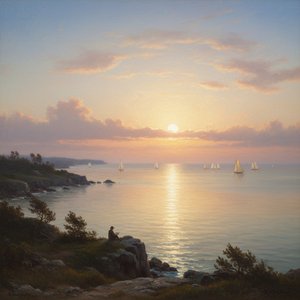
William Stanley Wyatt: Bridging Classicism and Spiritual Realism
Greg Wyatt is an American representational sculptor who primarily works in cast bronze, establishing himself as a prominent figure in contemporary sculpture while deeply rooted in the traditions of Western art history. Born in Nyack, New York, in 1949, Wyatt’s artistic journey began under the influence of his father, William Stanley Wyatt—a painter and professor at Columbia University, Rockland Community College, and City College of New York—who instilled a passion for visual arts from an early age. This formative experience shaped Wyatt's lifelong dedication to exploring the intersection between classical ideals and expressive abstraction.
Wyatt’s academic pursuits culminated in a Bachelor of Arts degree in Art History from Columbia College in 1971, followed by intensive study at the National Academy of Design for three years where he honed his sculptural skills under Evangelos Frudakis. He further refined his craft with a Master's Degree in Ceramic Arts from Columbia Teachers College in 1974, demonstrating versatility and commitment to mastering diverse artistic mediums. Throughout his teaching career at New York University and Jersey City State College, Wyatt nurtured the creativity of aspiring artists and disseminated knowledge about art history—a testament to his belief in the transformative power of education.
His philosophy centers around “spiritual realism,” a method that synthesizes meticulous observation with imaginative abstraction—a stylistic approach lauded by Professor Sir Stanley Wells, CBE, who likened Wyatt to Rodin, recognizing his exceptional talent. "Wyatt emulates the sculpture of the western world with contemporary vision," Wells noted. This distinctive style reflects Wyatt’s profound understanding of artistic heritage while simultaneously pushing boundaries and exploring new expressive possibilities. He draws inspiration from the Hudson River School painters—particularly Jasper F. Cropsey—whose landscapes capture the grandeur and sublime beauty of nature, mirroring Wyatt's own fascination with capturing emotion and conveying spiritual depth in his sculptures.
Wyatt’s prolific output includes monumental bronze sculptures like *Wind God*, *Peace Fountain*, and *Frederick Douglass*—each embodying a powerful statement about human dignity and social justice. His commission for J.C. Penney founder James Cash Penney's statue weighs 3 tons and represents a significant undertaking in sculptural craftsmanship, showcasing Wyatt’s technical mastery alongside his artistic vision. Furthermore, his works have been exhibited at prestigious institutions such as The Metropolitan Museum of Art, Harvard University, and Vanderbilt Mansion National Historic Site—reaching audiences worldwide and cementing his place among America’s leading sculptors.
- Notable Works: *Wind God*, *Peace Fountain*, *Frederick Douglass*
- Influences: Hudson River School painters (particularly Jasper F. Cropsey), Classical Sculpture
- Teaching Experience: New York University, Jersey City State College
Wyatt’s artistic legacy is characterized by a lifelong pursuit of excellence and a steadfast commitment to engaging with complex themes—both aesthetically and intellectually. He continues to inspire artists and scholars alike, solidifying his place as one of the most influential sculptors of our time.