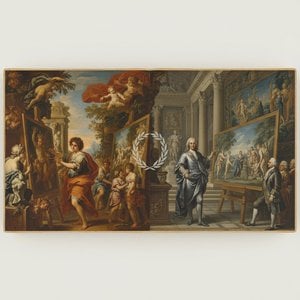
Goliardo Padova: A Painter of Light and Shadow
Goliardo Padova (1909-1979) emerged from Casale Monferrato, Italy, a region steeped in artistic tradition, to become a celebrated painter known for his masterful depictions of interiors and religious scenes. His distinctive style blended meticulous observation with expressive brushwork, resulting in canvases that captured both the tangible beauty of everyday life and profound spiritual contemplation. Padova’s artistic journey began at the Istituto d'Arte di Parma where he honed his skills under Giuseppe Palanti, establishing a foundation for his subsequent studies at the Accademia di Brera in Milan—a crucible of Italian art history.
Early Influences: Padova’s formative years were marked by exposure to Impressionism and Neo-Romanticism, movements that instilled in him an appreciation for capturing fleeting moments of light and emotion. These influences are particularly evident in his early landscapes, characterized by luminous color palettes and atmospheric perspective—a technique he would later refine throughout his prolific career. He sought inspiration from masters like Claude Monet and Eugène Delacroix, recognizing the importance of conveying mood and sensation alongside accurate representation.
Academic Training & Artistic Style: Padova’s formal training at Brera solidified his technique—primarily oil painting—and fostered a disciplined approach to artistic representation. He embraced realism while simultaneously injecting subtle nuances of feeling into his compositions, reflecting the humanist spirit of the era. Padova meticulously studied anatomy and perspective, mastering the tools necessary to achieve convincing depictions of form and space. His unwavering dedication to craftsmanship ensured that every brushstroke conveyed intention and contributed to the overall impact of his artwork.
Padova's oeuvre encompasses a diverse range of subjects, ranging from serene domestic interiors bathed in soft light—often illuminated by candlelight—to dramatic depictions of biblical narratives imbued with emotional intensity. He possessed an extraordinary ability to capture the essence of human experience, portraying figures with sensitivity and nuance. His masterful use of chiaroscuro – the interplay of light and dark – created depth and drama within his paintings, drawing viewers into a contemplative state. Padova’s compositions were marked by careful balance and harmonious color schemes, demonstrating his profound understanding of artistic principles.
Notable Works: Among Padova’s most acclaimed pieces are “Campi irrigati” (Irrigated Fields), a vibrant landscape showcasing the Tuscan countryside—a scene he revisited repeatedly throughout his life—and “Autunno” (Autumn), which captures the melancholic beauty of autumnal foliage with breathtaking detail. His series of prints featuring Saint Jerome meditating in the desert exemplifies his ability to convey spiritual themes with visual eloquence, demonstrating his mastery of xilography and illustration alongside painting. Padova’s contribution to Italian art is significant not only for his stylistic innovations but also for his role as a teacher, nurturing generations of aspiring artists in Milan—inspiring them to pursue excellence and embrace artistic exploration. He remains an artist whose work embodies the enduring power of beauty and contemplation, securing his place among the luminaries of 20th-century Italian art.