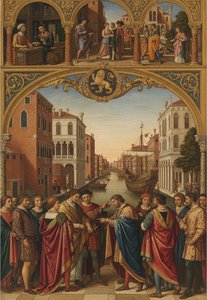
Giovanni Buonconsiglio (1465-1537): Venetian Renaissance Master
Giovanni Buonconsiglio, born in Vicenza around 1465, stands as a pivotal figure within the Venetian Renaissance artistic landscape. His career spanned nearly seven decades, marked by prolific output and an unwavering dedication to capturing the grandeur of religious iconography and portraiture—a testament to his mastery of technique and stylistic evolution. While biographical details remain somewhat sparse, Buonconsiglio’s legacy resides primarily in his stunning paintings that continue to inspire admiration for their beauty and spiritual depth.
Early Apprenticeship and Influences
Buonconsiglio's artistic journey commenced with an apprenticeship under Bartolomeo Montagna in Vicenza, establishing a foundational grounding in Venetian painting traditions. By 1484, he was already demonstrating considerable talent, absorbing the stylistic precepts of Montagna’s workshop—primarily characterized by meticulous detail and a restrained palette. However, Buonconsiglio's artistic sensibilities broadened considerably when he became a pupil of Antonello da Messina, arguably the most influential artist of his time. Messina’s mastery of oil painting techniques and his embrace of linear perspective profoundly impacted Buonconsiglio’s approach to composition and rendering, propelling him toward a more sophisticated visual language. This formative period instilled in Buonconsiglio an appreciation for precision and realism—elements that would permeate his subsequent artistic endeavors.
Vicenza Commissions: Pieta and Virgin Mary
Buonconsiglio's artistic output flourished in Vicenza, where he undertook significant commissions for ecclesiastical patrons. Notably, he created a monumental Pietà for the chiesa di San Bartolomeo—a masterpiece that exemplifies Buonconsiglio’s meticulous attention to anatomical accuracy and emotional expression. The painting skillfully portrays Mary cradling Jesus’s lifeless body with serene dignity, reflecting Messina's influence on Buonconsiglio’s stylistic choices. Buonconsiglio meticulously studied human anatomy, mirroring Messina’s dedication to realism, ensuring that every muscle and bone conveyed the profound sorrow of mourning. Furthermore, he executed a depiction of the Virgin Mary flanked by saints for Oratorio de Turchini, demonstrating his ability to convey profound spiritual contemplation through nuanced color harmonies and sculptural modeling. Buonconsiglio's Pietà remains an enduring symbol of Venetian piety and artistic excellence—a testament to his unwavering commitment to conveying religious emotion with breathtaking visual impact.
Venetian Career: Altarpieces and Patronage
Buonconsiglio’s artistic endeavors extended beyond Vicenza into Venice, where he secured commissions from prominent churches and aristocratic families. His Venetian works showcase a stylistic refinement honed by prolonged engagement with the Venetian art scene—characterized by luminous colors and an emphasis on atmospheric perspective. Among his celebrated altarpieces are monumental depictions of St Catherine for Louvre and St Sebastian with St Roch and St Lawrence, reflecting Buonconsiglio’s commitment to portraying saints with palpable emotion and conveying religious narratives with compelling visual clarity. Buonconsiglio's meticulous attention to detail—a hallmark of Venetian painting—transformed these canvases into immersive experiences for the viewer, transporting them into the sacred realm of faith. Sadly, many of Buonconsiglio’s Venetian paintings perished during the fires that ravaged Venice in the 17th century, leaving only fragments as tangible reminders of his artistic prowess.
Notable Works and Legacy
Giovanni Buonconsiglio’s oeuvre comprises a diverse range of subjects—ranging from portraits to religious scenes—each imbued with an unmistakable Venetian aesthetic. His Virgin and Child (1511) for Montagnana Cathedral exemplifies Buonconsiglio's ability to capture the tenderness of maternal devotion while adhering to Messina’s influence on Buonconsiglio’s stylistic choices. The Madonna with Six Saints (Venice, Gallerie dell'Accademia) stands as a testament to Buonconsiglio’s masterful rendering of drapery and facial expressions—capturing the solemn beauty of religious iconography. Fragments exist of a work in oil for ss. Cosmo e Damiano alla Giudecca representing ss. Benedict,Tecla, and Cosmo (1407), showcasing Buonconsiglio's early artistic explorations. Buonconsiglio’s enduring contribution to Venetian Renaissance art lies not merely in his technical skill but also in his ability to imbue his paintings with spiritual resonance—a legacy that continues to captivate viewers centuries after his lifetime. Buonconsiglio’s meticulous observation of nature and masterful manipulation of color solidified his place as one of the foremost artists of his era, ensuring that his works would endure as emblems of Venetian artistic grandeur.