George Vicat Cole RA: Painter of Surrey’s Tranquil Landscapes
George Vicat Cole (1833 – 1893) stands as a prominent figure in Victorian landscape painting, celebrated for his ability to distill the beauty of Surrey and Sussex into exquisitely rendered canvases. Born into an artistic lineage—his father, George Cole, was himself a respected landscape artist—Cole inherited a passion for capturing the sublime grandeur of the English countryside and skillfully translated this fascination onto canvas. His work embodies the Romantic spirit, prioritizing emotional resonance alongside meticulous observation of nature’s subtleties.
Early Life & Artistic Training: Cole's formative years were spent in Portsmouth, where he received a grounding in artistic principles from his father. This familial influence undoubtedly shaped his approach to painting and instilled within him a dedication to mastering the craft. He began sketching outdoors at a young age, diligently studying topographical maps and sketches to faithfully reproduce landscapes—a practice that would characterize his entire artistic career. Cole’s father encouraged him to emulate the masters of Romanticism, particularly Turner and David Cox, fostering an appreciation for dramatic lighting and expressive brushwork.
Royal Academy Debut & Recognition: Cole’s ambition propelled him towards London, where he debuted at the British Institution in 1853 at just nineteen years old—a remarkable achievement for someone of his age. His election as an Associate Academician of the Royal Academy in 1870 solidified his position within the art world and cemented his reputation as a serious artist. This honor recognized Cole’s unwavering commitment to artistic excellence and established him as one of the leading landscape painters of his generation. He continued to refine his technique, experimenting with different mediums and palettes while maintaining a steadfast focus on capturing the essence of the English countryside.
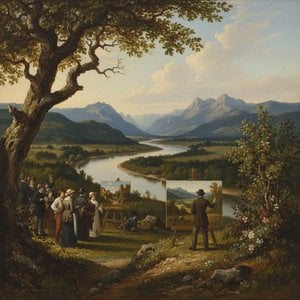
Cole’s artistic style is characterized by its simplicity and directness, prioritizing clarity of form and luminous color palettes. He eschewed elaborate ornamentation, favoring instead a technique that allowed him to convey the mood and atmosphere of his subjects—typically rolling hills dotted with sheep, meandering rivers reflecting the sky, and picturesque villages nestled amongst verdant landscapes—with remarkable accuracy. This understated approach proved remarkably successful in capturing the mood and atmosphere of Surrey and Sussex, becoming synonymous with the idyllic vistas favored by Victorian viewers. He meticulously blended pigments to achieve subtle tonal variations, creating paintings that possessed a palpable sense of depth and luminosity.
Subject Matter & Inspiration: Cole’s artistic focus remained steadfast on depicting rural England, drawing inspiration from the Romantic tradition's reverence for nature. He diligently studied topographical maps and sketches to faithfully reproduce landscapes, employing a technique that combined observation with careful compositional planning. His subjects often included scenes of Dartmoor National Park, reflecting his deep connection to the wild beauty of Devonshire. Cole’s paintings are imbued with a sense of tranquility and contemplation—a testament to his belief in art's ability to inspire awe and wonder.
Notable Works & Legacy: Among Cole’s most celebrated paintings is “The Pool of London,” purchased by the Chantrey Fund Trustees in 1888 and subsequently exhibited at the Tate Gallery—a testament to Cole’s artistic prowess and enduring appeal. This monumental canvas captures the dynamism of the Thames Estuary with masterful brushwork and vibrant color, demonstrating Cole's ability to convey both visual splendor and emotional intensity. His landscapes continue to inspire admiration for their serene beauty and meticulous execution, securing his place as one of the era's foremost landscape painters—a legacy that resonates today through the enduring power of Romantic art. Cole’s work exemplifies the Victorian ideal of artistic integrity: a dedication to honest observation and skillful representation of the natural world.