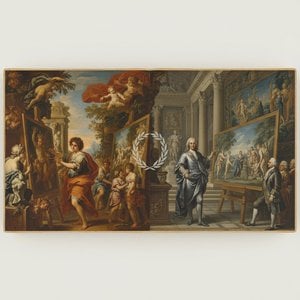
Gabriel Germain Boffrand: Bridging Baroque and Rococo’s Legacy
Gabriel Germain Boffrand (1667-1754) stands as a pivotal figure in French art history, marking the transition between the grandeur of Baroque architecture and the playful exuberance of Rococo. Born in Nantes, France, he honed his craft under the tutelage of Jules Hardouin Mansart, inheriting the baroque’s emphasis on monumental scale and dramatic ornamentation while simultaneously embracing innovations that would define a new aesthetic – one characterized by delicate curves, pastel colors, and an obsession with illusionistic decoration. His influence extended far beyond his own lifetime, shaping the visual landscape of Louis XV France and inspiring generations of architects to come.
Early Life and Training: The Foundations of Baroque Mastery
Boffrand’s formative years were spent absorbing the principles of baroque design from Mansart, a movement that prioritized grandeur, clarity, and mathematical precision. This foundational knowledge would prove invaluable as he embarked on his independent architectural career. Recognizing Mansart's genius, Boffrand diligently studied his techniques—particularly in achieving spatial harmony and utilizing sculptural ornamentation—establishing himself as a disciple committed to upholding the baroque tradition’s exacting standards. Notably, he apprenticed under François Girardon, mastering the art of sculpting monumental figures with meticulous detail and conveying emotion through expressive poses. This early training instilled within him an unwavering dedication to craftsmanship and artistic excellence.
Major Commissions and Architectural Achievements: Shaping Parisian Splendor
Boffrand's prolific output included ambitious projects that cemented his reputation as one of France’s foremost architects. The Hôtel de Soubise in Paris—arguably the quintessential embodiment of Rococo style—represents a pinnacle of his creative vision. Here, he skillfully blended opulent interiors with innovative spatial arrangements, creating a breathtaking palace that captivated visitors with its airy proportions and shimmering surfaces. Equally impressive was his contribution to the Musée du Château Blois, showcasing a masterful blend of classical restraint and rococo embellishment – demonstrating Boffrand’s ability to synthesize disparate stylistic influences into harmonious compositions. Furthermore, he undertook the remodeling of the Petit-Luxembourg gardens, transforming them into a verdant oasis reflecting Louis XV's refined tastes.
The Livre d’Architecture: A Catalyst for Rococo Diffusion
Perhaps Boffrand's most enduring legacy resides in *Livre d’architecture* (1745), his treatise on architectural design. Published during the reign of Louis XV, this seminal work served as a catalyst for spreading the “Style Régence” – a transitional style that foreshadowed Rococo—across Europe. Unlike the rigid formalism of earlier baroque treatises, Boffrand's Livre championed a more humanist approach, advocating for harmonious proportions and incorporating elements of Italian Renaissance ideals alongside rococo flourishes. It meticulously documented techniques for achieving visual effects like trompe-l’œil and perspective projection, solidifying Boffrand’s position as a champion of artistic innovation and establishing him as a pivotal figure in shaping architectural discourse.
Influence and Legacy: An Architect Beyond His Time
Boffrand's influence extended far beyond his own lifetime, inspiring generations of architects to come. He collaborated closely with Robert de Cotte, the new first architect of the king, fostering a dialogue between classical tradition and rococo experimentation—a partnership that resulted in landmark projects like the Residenz in Würzburg. His meticulous attention to detail—evident in the Hôtel Soubise’s oval salon and the Petit-Luxembourg gardens—continues to inspire admiration for its harmonious blend of form and decoration. Despite the challenges posed by documentation loss and demolition, Boffrand's architectural achievements endure as symbols of French artistic excellence and testament to his unwavering commitment to pushing the boundaries of stylistic innovation. He remains an indispensable figure in understanding the evolution of European art and architecture during the Enlightenment—a true bridge between two magnificent eras.